The International union for the Conservation of Nature (IUCN) is the world’s largest and oldest global environmental network, founded in 1948. It brings together both sovereign states and government agencies alongside non-governmental organizations (NGOs) and thousands of scientific experts.
The IUCN Red List of Threatened Species, established in 1964, it is the world’s most comprehensive inventory of the global conservation status of biological species (animals, plants, and fungi). It classifies species into strict scientific categories:
- Extinct (EX)
- Extinct in the Wild (EW)
- Critically Endangered (CR)
- Endangered (EN)
- Vulnerable (VU)
- Near Threatened (NT)
- Least Concern (LC).
The [IUCN Red List of Ecosystem](Red List of Ecosystems) (IUCNRLE) categories
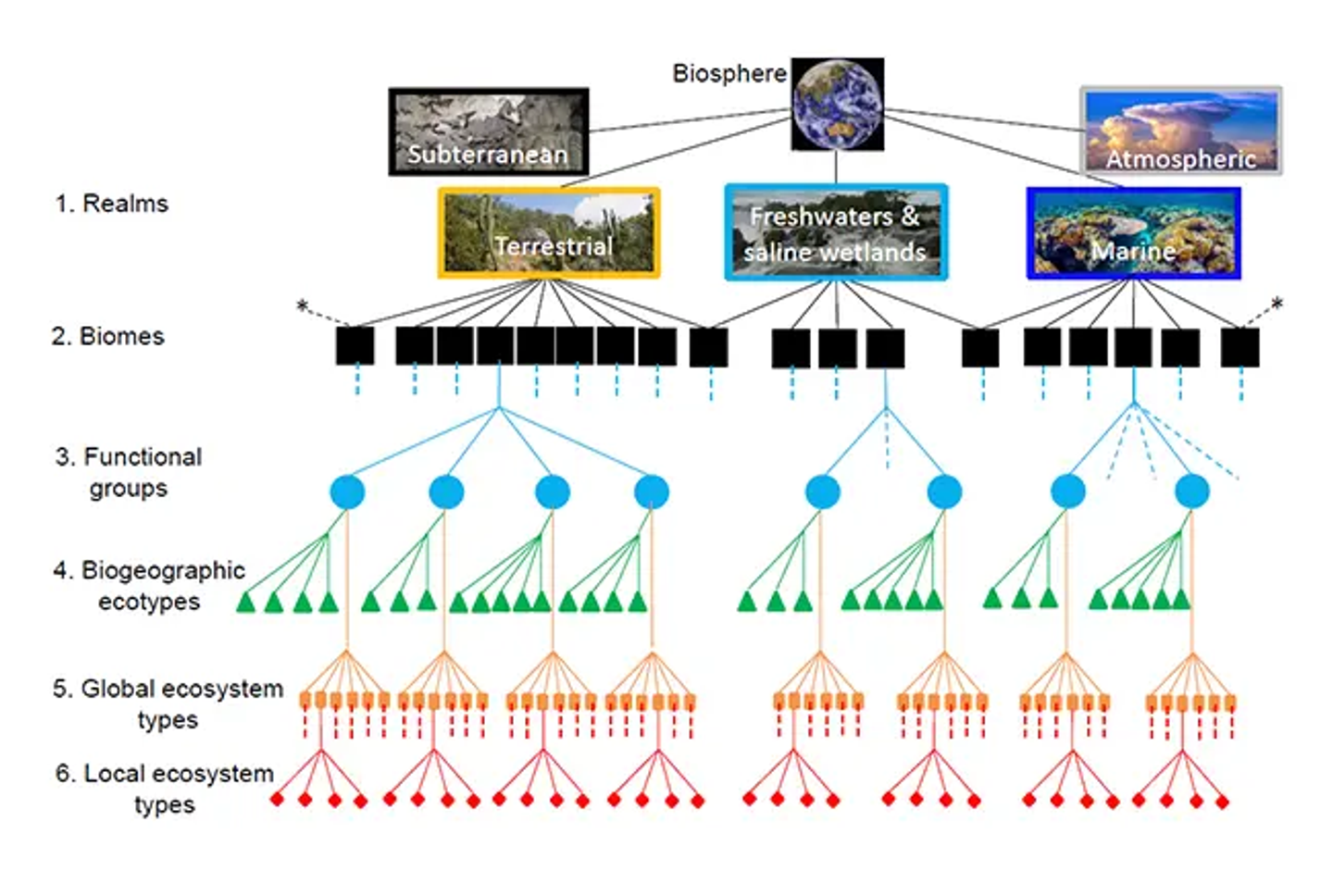
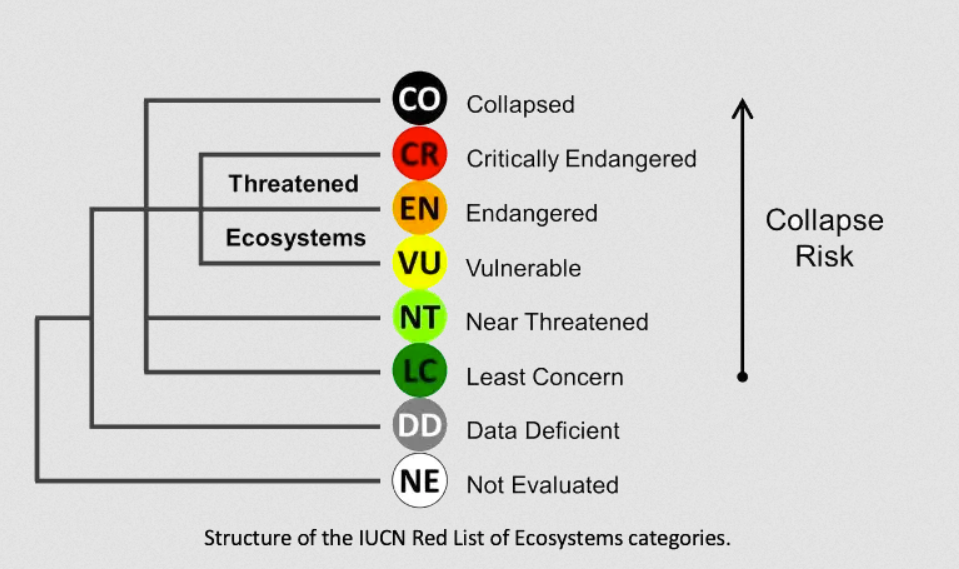
The work of the IUCN
| IUCN Working Themes | IUCN Working Regions |
|---|---|
| - Biodiversity - Business finance and economy - Climate Change - Freshwater and Water security - Governance law and rights - Nature-based solutions - The Oceans and Coasts - Protected areas | - Asia - Easter and Southern Afria - Eastern Europe and Central Asia - Europe - Mediterranean - Mexico, central America and the Caribbean - North America - Oceania - West and Central Africa - West Asia |
Conclusions
Documents and sources of interest
The IUCN Academy is the official educational arm providing professional training, certificates, and capacity-building programs in environmental law, nature-based solutions, and conservation governance.
The Integrated Biodiversity Assessment Tool (IBAT) is a high-level decision support platform used primarily by businesses, governments, and researchers. It integrates data from the Red List, World Database on Protected Areas, and Key Biodiversity Areas to help organizations map out risk assessments before starting infrastructure or development projects.
The Global Invasive Species Database (GISD) is a specialized database focused on tracking invasive alien species that threaten native biodiversity. It provides global evidence on species profiles, distribution, and eradication or management strategies.
[Key Biodiversity Areas](Key Biodiversity Areas) (KBA) is a registry identifying specific sites on land, water, or sea that contribute significantly to the global persistence of biodiversity.
The [IUCN Green List](IUCN Green List) is a global standard and certification program that recognizes protected and conserved areas achieving fair governance, sound planning, and effective conservation outcomes. It held its recent major Awards Ceremony at the COP16 in Cali, Colombia.
The Bonn Challenge: A global effort aligned with IUCN to restore 350 million hectares of degraded and deforested lands.
- 100 of the world’s worst invasive alien species