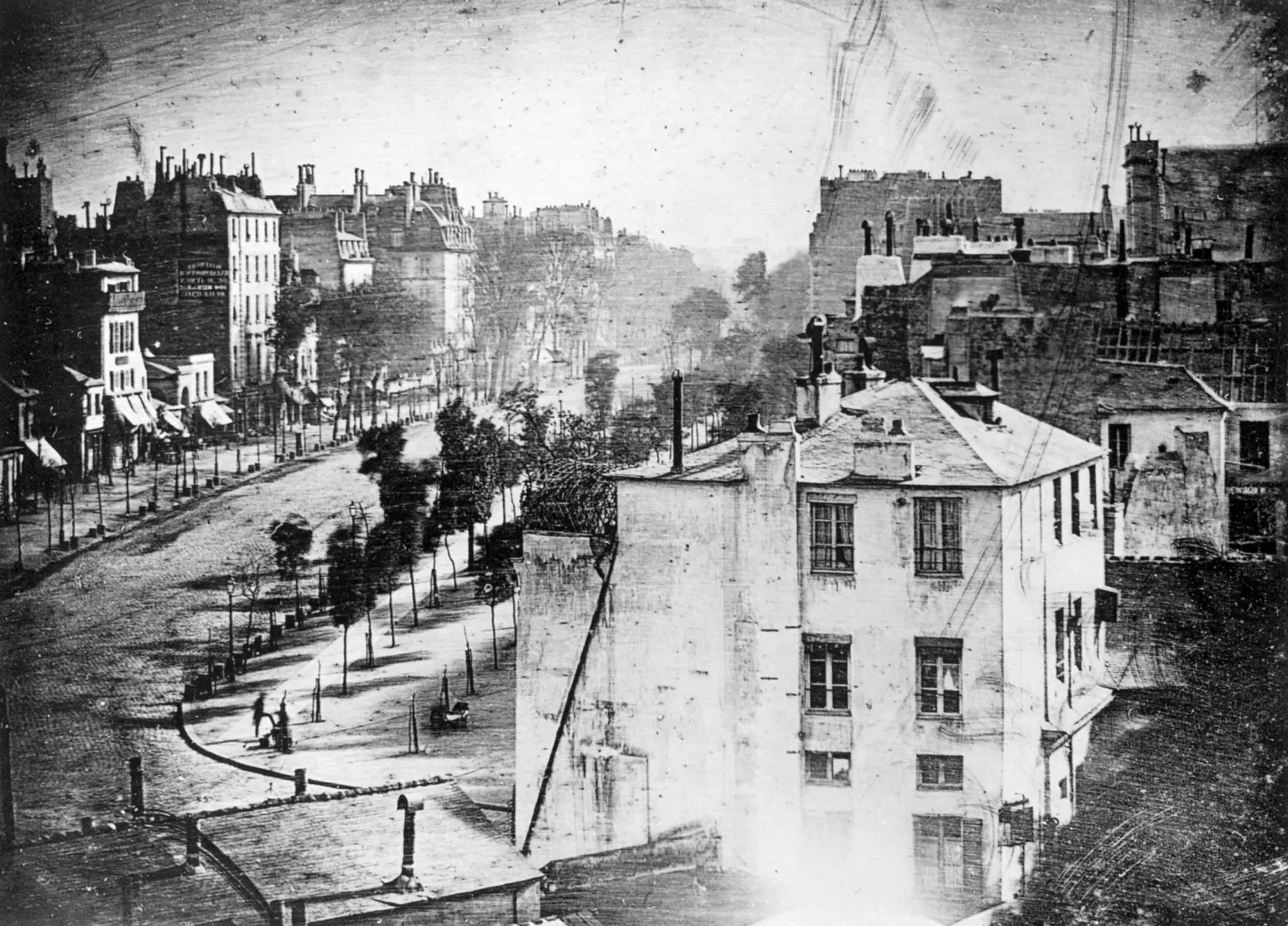
The photograph of the Boulevard du Temple taken by Louis Daguerre in 1838 is universally recognized as the first photograph ever to capture a human being.
The most fascinating anomaly of this image is that the Boulevard du Temple was one of the busiest, most bustling streets in Paris at the time, filled with horse-drawn carriages and pedestrians. Yet, in the photograph, the vast avenue appears entirely deserted.
This ghostly vacuum is due to the technology of early photography. The chemical plate required an incredibly long exposure time of roughly 10 minutes. Because carriages, horses, and walkers were constantly moving, they didn’t stay in one spot long enough to register on the plate, making them completely invisible to the camera.
There is a single exception located in the lower-left corner of the image. Look closely at the silhouette of a man standing still to get his boots polished
Because he remained relatively motionless for several minutes, his shape—along with the blurred figure of the shoe-shiner working at his feet—had enough time to burn onto the daguerreotype plate. These anonymous individuals unintentionally became the very first humans ever recorded in a photograph.
A technical detail to note when looking at this print is that the daguerreotype process naturally created a reversed mirror image of reality. Unless corrected later with a specialized mirror prism inside the camera, everything on the left side of the final photograph actually existed on the right side of the real Parisian street