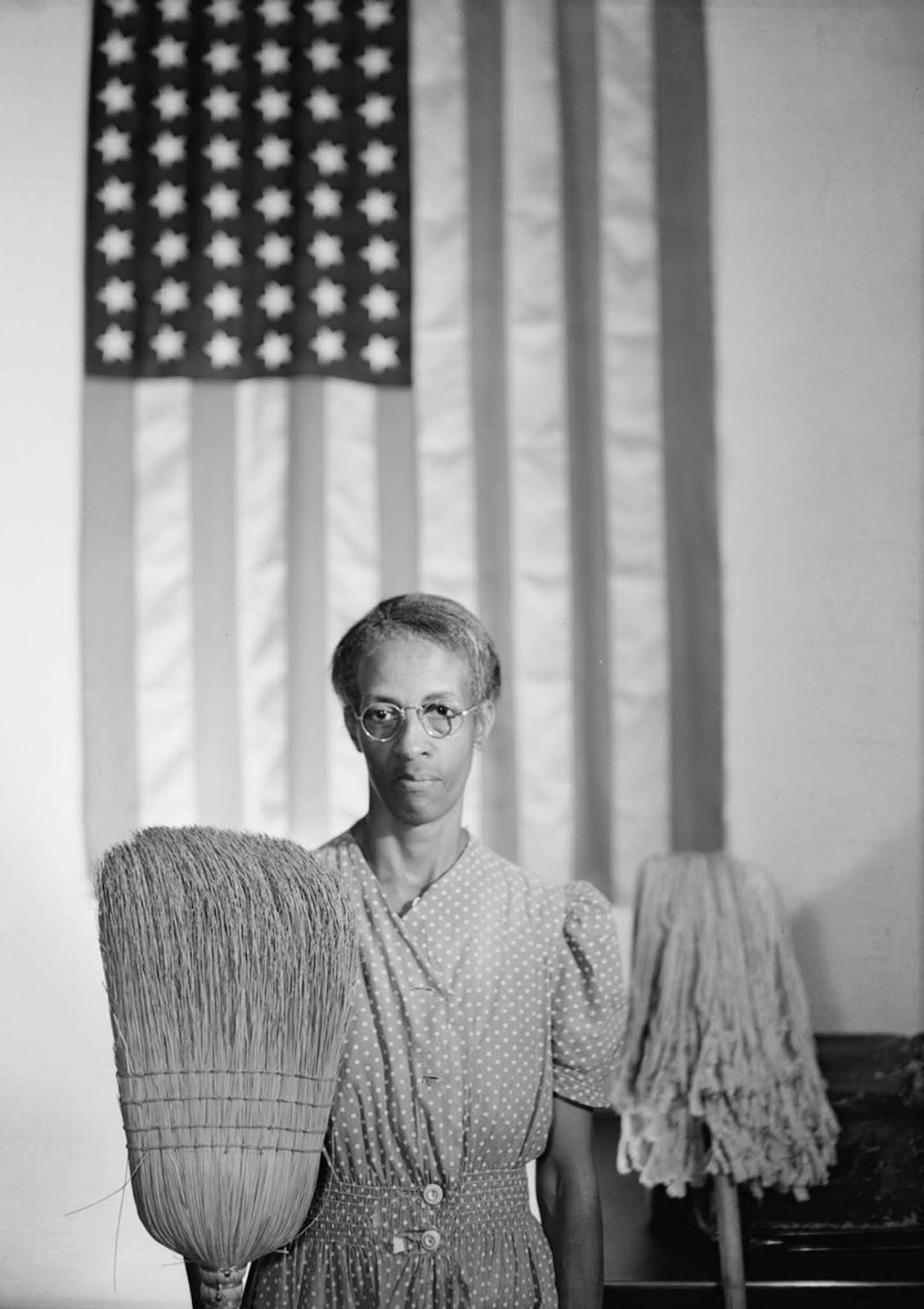
The woman in the portrait is Ella Watson, who worked as a charwoman (janitor) in the very building where the Farm Security Administration (FSA) was headquartered. Parks, who had just arrived in Washington, D.C. on a fellowship, was deeply shocked by the intense, overt racism and segregation he experienced in the nation’s capital.
After striking up a conversation with Watson, he learned about her grueling life: she supported her children and grandchildren on a meager government cleaning salary. Parks decided to spend the summer collaborating with her to document her daily routine, church community, and home life.
Watson is positioned dead center, holding a broom in one hand with a mop resting behind her. These tools symbolize the low-wage, systemic domestic labor to which Black women were largely restricted at the time.
The Flag: She stands directly in front of a massive, slightly out-of-focus American flag. The juxtaposition heavily critiques the gap between America’s patriotic ideals of freedom and equality, and the reality of state-sanctioned racial oppression.
The Expression: Watson’s expression is stoic, exhausted, yet profoundly dignified, refusing to be reduced merely to a victim.
The title and composition are a direct, subversive parody of Grant Wood’s famous 1930 painting, American Gothic. While Wood’s painting depicted a white, rural farmer holding a pitchfork as a symbol of traditional American resilience, Parks replaced them with a urban, working-class Black woman holding a broom. By doing so, Parks forced a bold redefinition of who truly belonged to—and built—the American landscape.