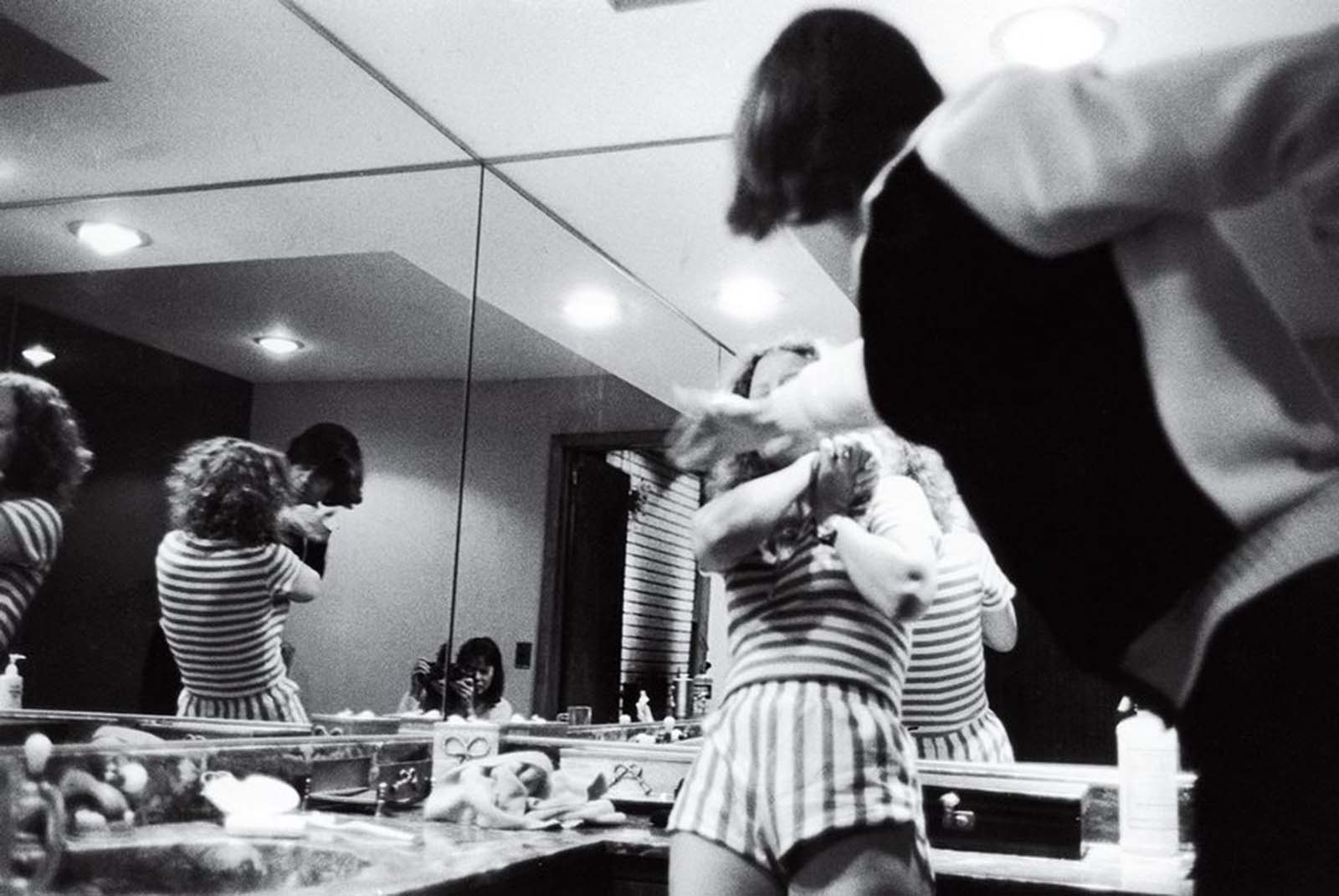
Behind Closed Doors
When Ferrato attempted to intervene to protect Lisa, the husband brushed her off entirely, chillingly asserting that he was simply exercising his “right to discipline his wife”.
Even more shocking was the reaction of the media establishment at the time. When Ferrato brought the stark proof of abuse to various magazine editors, virtually every publication refused to print it. Editors argued that domestic disputes were private, family matters that did not belong in public view. The photograph remained unpublished for nearly a decade until Ferrato funded and released her own landmark book on domestic abuse in 1991, also titled Living with the Enemy.
“Behind Closed Doors” (1982) is not a film or a book, but one of the most raw, shocking, and influential documentary photographs in the history of 20th-century photojournalism. Captured by American photographer and activist Donna Ferrato, it is officially listed by TIME magazine as one of the 100 Most Influential Photographs of All Time.
The image freezes an explicit, unvarnished look at the brutal reality of domestic violence and gender-based abuse.
In 1982, the Japanese edition of Playboy magazine commissioned Donna Ferrato to shoot a glamorous photo essay documenting the lifestyle of wealthy, successful swinger couples living in the affluent suburbs of New Jersey.
During the assignment, Ferrato met a wealthy, seemingly happy couple whom she originally photographed under the pseudonyms of “Garth” and “Lisa” (decades later revealed to be Bengt and Elisabeth). Ferrato temporarily moved into their mansion to document their high-end routine. However, the facade of perfection hid a dark dynamic fueled by cocaine addiction and intense jealousy.
One night, Ferrato was startled awake by Elisabeth’s desperate screams coming from the master bathroom. When she walked in with her camera, she found Bengt completely enraged, physically assaulting his wife.
Driven by pure journalistic instinct and a desire to document the crime, Ferrato lifted her camera and pressed the shutter. The photograph freezes the exact millisecond the man raises his hand to violently slap his wife, while the photographer’s own reflection capturing the scene is immortalized in the bathroom mirror. Ferrato naively thought the flash would stop the attacker, but her presence was completely ignored.
While it is celebrated as a historic icon today, the path to getting the image published was incredibly difficult:
-
The Editors’ Rejection: When Ferrato took her work to major magazines at the time, every single editor refused to publish it. In the 1980s, domestic abuse was still widely dismissed as a “private family matter” that the press and the law should not interfere with. The attacker himself even told Ferrato that he was “just exercising his right to discipline his wife.”
-
The Book That Shattered the Silence (1991): Blocked by mainstream media outlets, Ferrato spent an entire decade riding in police cars, visiting women’s shelters, and documenting emergency rooms to gather an undeniable archive of domestic abuse. This heartbreaking work was finally self-published in 1991 in her milestone book titled Living with the Enemy.
-
A Tool for Justice: The photograph ultimately served as crucial physical evidence that helped Elisabeth secure a divorce, win custody of her children, and legally remove her abuser from her life forever.