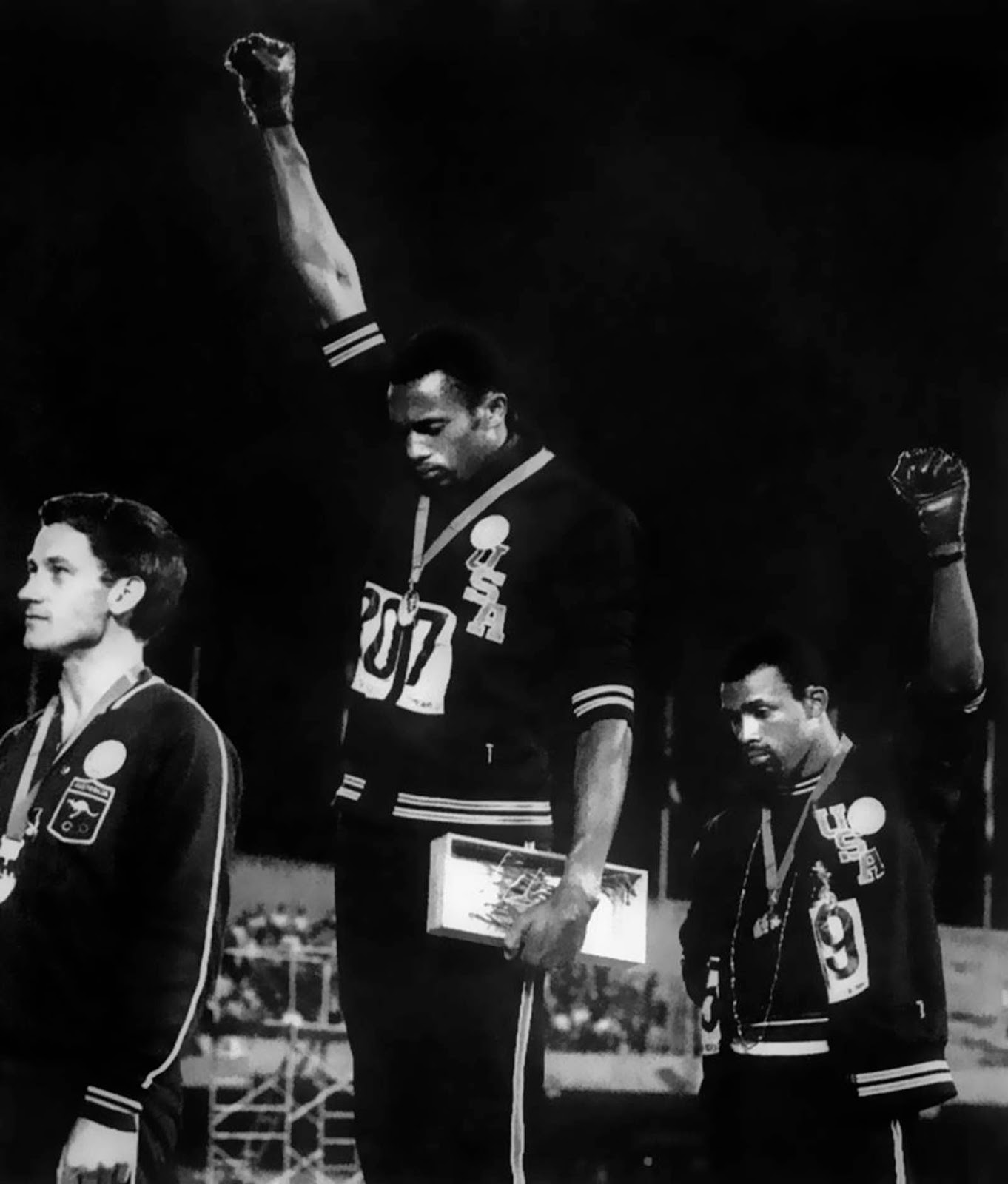
The “Black Power salute” most famously refers to the moment at the 1968 Mexico City Olympics when American sprinters Tommie Smith and John Carlos raised their fists during the medal ceremony for the 200-meter race.
On October 16, 1968, Smith won gold and Carlos won bronze (Australian Peter Norman took silver). During the playing of “The Star-Spangled Banner,” Smith and Carlos each raised a black-gloved fist and bowed their heads. They also stood on the podium shoeless, wearing black socks to represent Black poverty, and Smith wore a black scarf while Carlos wore beads, symbolizing lynching victims. Silver medalist Peter Norman, though not raising a fist himself, wore a badge in solidarity supporting the Olympic Project for Human Rights, the organization behind the protest.
The gesture was meant to draw attention to racial injustice and inequality in the United States and around the world, during a year already marked by the assassinations of Martin Luther King Jr. and Robert Kennedy, and widespread civil rights unrest. Smith and Carlos were both involved with the Olympic Project for Human Rights, which had considered a broader boycott of the games before settling on this form of protest.
The International Olympic Committee, led by Avery Brundage, deemed the gesture a political statement inappropriate for the Olympics and had Smith and Carlos expelled from the Olympic Village and sent home. Both men faced significant backlash in the U.S. at the time, including threats and difficulty finding work. Norman, too, faced consequences back in Australia for his show of support.
Over time, the image became one of the most iconic photographs in sports history and is now widely celebrated as a landmark moment in the history of athlete activism. Smith and Carlos were later honored by the U.S. Olympic Committee, and a statue commemorating the moment stands at San Jose State University, where both had been students.