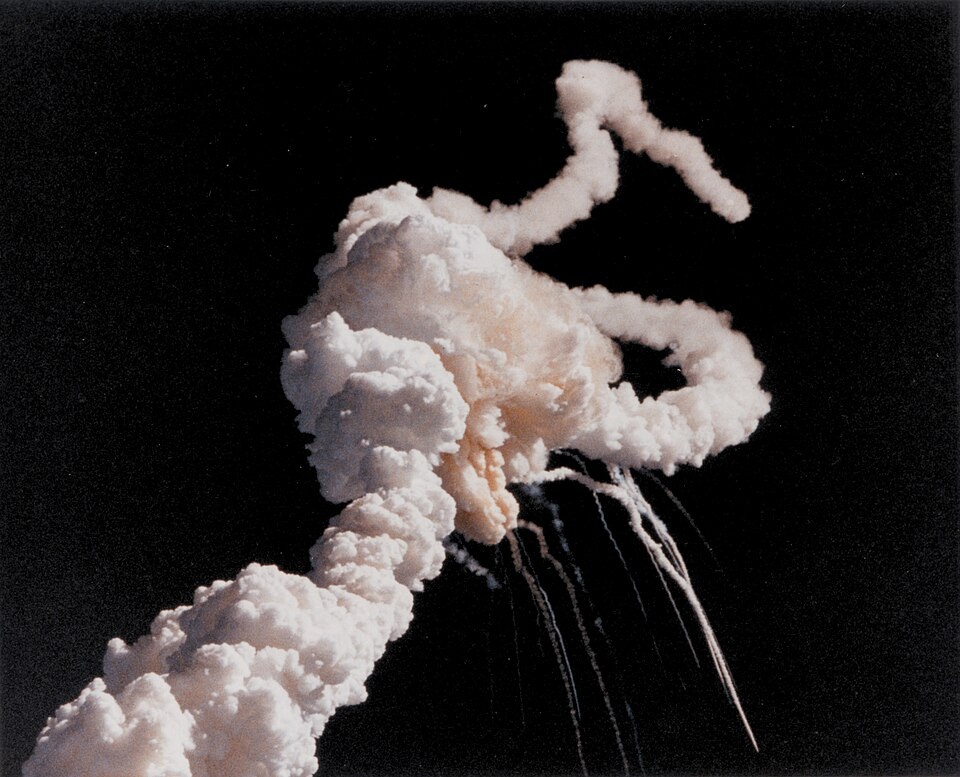
The Challenger disaster was the catastrophic in-flight breakup of the Space Shuttle Challenger on January 28, 1986, just 73 seconds after launch, killing all seven crew members aboard.
The mission, STS-51-L, carried commander Francis “Dick” Scobee, pilot Michael Smith, mission specialists Judith Resnik, Ellison Onizuka, and Ronald McNair, and payload specialists Gregory Jarvis and Christa McAuliffe. McAuliffe was a New Hampshire schoolteacher selected through NASA’s Teacher in Space Project, and her participation drew enormous public attention — many American schoolchildren were watching the launch live on television specifically because of her.
The disaster was caused by the failure of an O-ring seal in one of the shuttle’s solid rocket boosters. The launch took place on an unusually cold morning in Florida, with temperatures well below what the boosters had previously flown in. The cold caused the rubber O-ring to lose flexibility, and it failed to seal properly, allowing hot gas to escape and ultimately breach the external fuel tank, leading to the shuttle’s structural breakup.
Investigators later revealed that engineers at Morton Thiokol, the contractor that built the boosters, had raised serious concerns the night before launch about the O-rings’ performance in cold weather, but were overruled amid pressure to keep the mission on schedule — a decision that became a major focus of criticism.
The launch was broadcast live, and the sight of the shuttle disintegrating into a Y-shaped plume of smoke and debris over the Atlantic became one of the most indelible images of the era, especially since so many schoolchildren were watching because of McAuliffe. It was a profound national trauma, unfolding in real time on live television.
President Reagan postponed his State of the Union address and instead gave a televised speech honoring the crew. A presidential commission, the Rogers Commission (which included Richard Feynman, who famously demonstrated the O-ring’s cold-weather failure with a glass of ice water at a hearing), investigated the disaster and found fault not just in the technical failure but in NASA’s organizational culture and decision-making process. The shuttle program was grounded for nearly three years afterward, and safety and communication reforms followed.