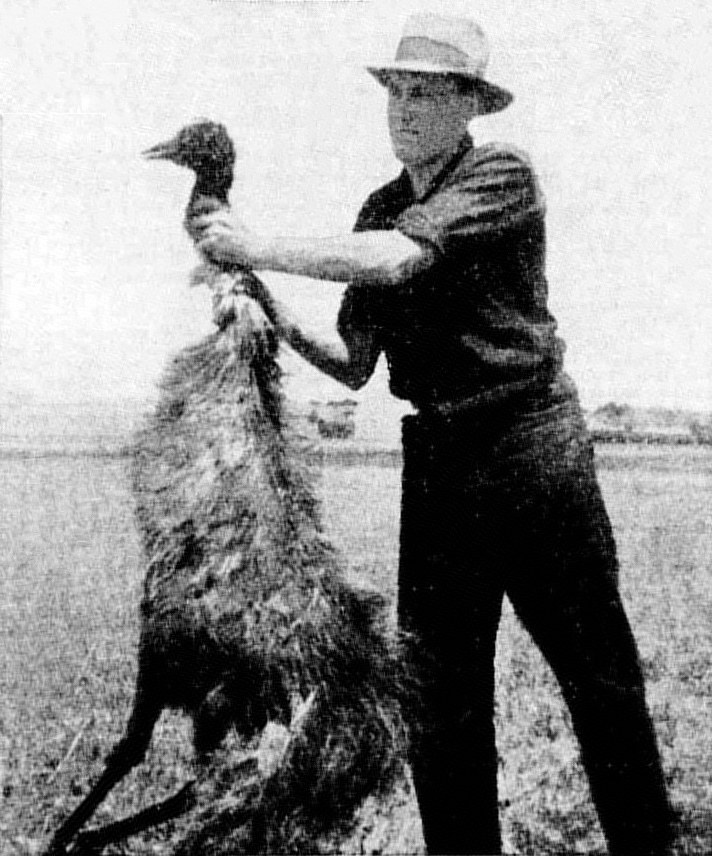
The “Emu War” was a peculiar 1932 military operation in Western Australia, where soldiers were deployed against emus — and it’s remembered largely as a farcical failure for the human side.
After World War I, many veterans were settled as farmers in Western Australia under a soldier-settlement scheme. By 1932, these farmers were struggling with the Great Depression and drought, and their wheat crops were being devastated by a massive migration of emus — tens of thousands of the large flightless birds moving inland after their breeding season, drawn to farmland in search of water and food.
Farmers, some of them WWI veterans themselves, appealed to the government for help. The Australian military, under Major G.P.W. Meredith, deployed soldiers armed with two Lewis machine guns to cull the emu population, treating it almost like a genuine military campaign.
The operation was a widely publicized embarrassment. Emus proved surprisingly difficult targets — they were fast, scattered erratically under fire, and could apparently absorb multiple hits and keep running. The birds moved in smaller, unpredictable groups rather than the large herds the soldiers had hoped to mow down efficiently, and mechanical issues with the guns (including one jamming during an ambush attempt) compounded the difficulty. After about a month, only a modest number of birds had been killed relative to the ammunition expended, and the operation was called off, generating mocking headlines in the press at the time.
The “Emu War” has since become a piece of enduring, somewhat comic Australian folklore — often cited as an example of humans losing to nature, referenced in memes, documentaries, and pop culture. Farmers ultimately dealt with the emu problem more effectively through bounty systems and exclusion fencing in subsequent years.