To Kill a Mockingbird (R. Mulligan, 1962)
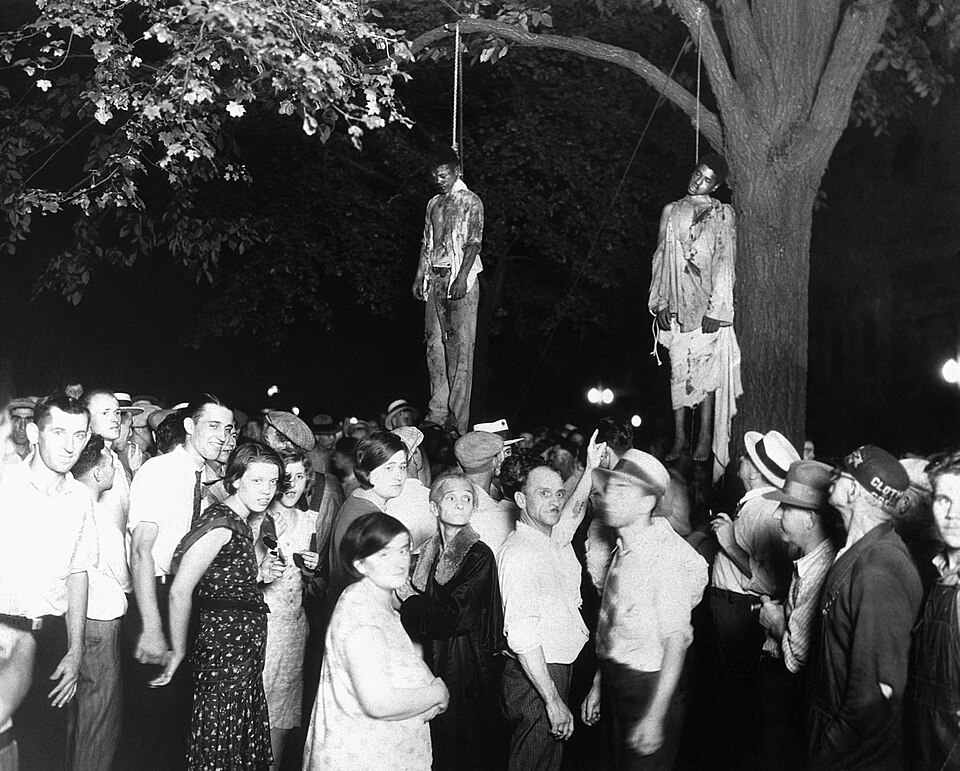
The lynching of Thomas Shipp and Abram Smith was a brutal racial hate crime and one of the most infamous extrajudicial executions in United States history. It occurred on the night of August 7, 1930, in the town of Marion, Indiana.
On August 6, 1930, three Black teenagers—Thomas Shipp (19), Abram Smith (18), and James Cameron (16)—were arrested by local police, accused of shooting and killing a 24-year-old white man named Claude Deeter during a robbery, and of sexually assaulting his fiancée, Mary Ball.
Although the charges were never proven in a court of law—and subsequent investigations cast serious doubt on the teenagers’ involvement and the validity of the sexual assault allegation—rumors spread like wildfire through the white community of Marion, igniting blind fury.
On the night of August 7, an enraged mob of thousands of white citizens (including men, women, and children) surrounded the Grant County jail where the three teenagers were being held. The local police, heavily outnumbered and offering zero physical resistance, allowed the mob to break down the prison doors with sledgehammers and crowbars.
-
Thomas Shipp was the first to be dragged out of his cell. He was brutally beaten by the crowd inside the jail and hanged from the bars of an exterior window. His lifeless body was later dragged to the town square.
-
Abram Smith tried to fight back with all his strength. Reports from the time indicate that the mob broke his arms before dragging him to the courthouse yard. He was hanged from a large maple tree next to Shipp’s body. Witnesses reported that Smith’s body was lowered and re-hanged multiple times to prolong his agony.
The youngest teenager, 16-year-old James Cameron, met a different fate. The mob had already placed a noose around his neck and beaten him severely as they marched him toward the hanging tree.
According to Cameron’s own account in his memoirs, at that final fatal moment, an unidentified voice from the crowd shouted: “This boy had nothing to do with the killing or the girl!” Surprisingly, the mob halted, removed the noose, and allowed him to walk back to the jail. Cameron survived, spent several years in prison as an alleged accessory, and went on to dedicate his life to civil rights activism, famously founding the America’s Black Holocaust Museum in Milwaukee.
Beitler sold thousands of copies of this photograph as “souvenirs” to local residents in the days following the event. However, copies eventually reached the National Association for the Advancement of Colored People (NAACP), which distributed the image across the northern United States to lobby Congress to pass a federal anti-lynching bill.