“Pillars of Creation” is one of the most famous astronomical images ever taken, captured by the Hubble Space Telescope in 1995.
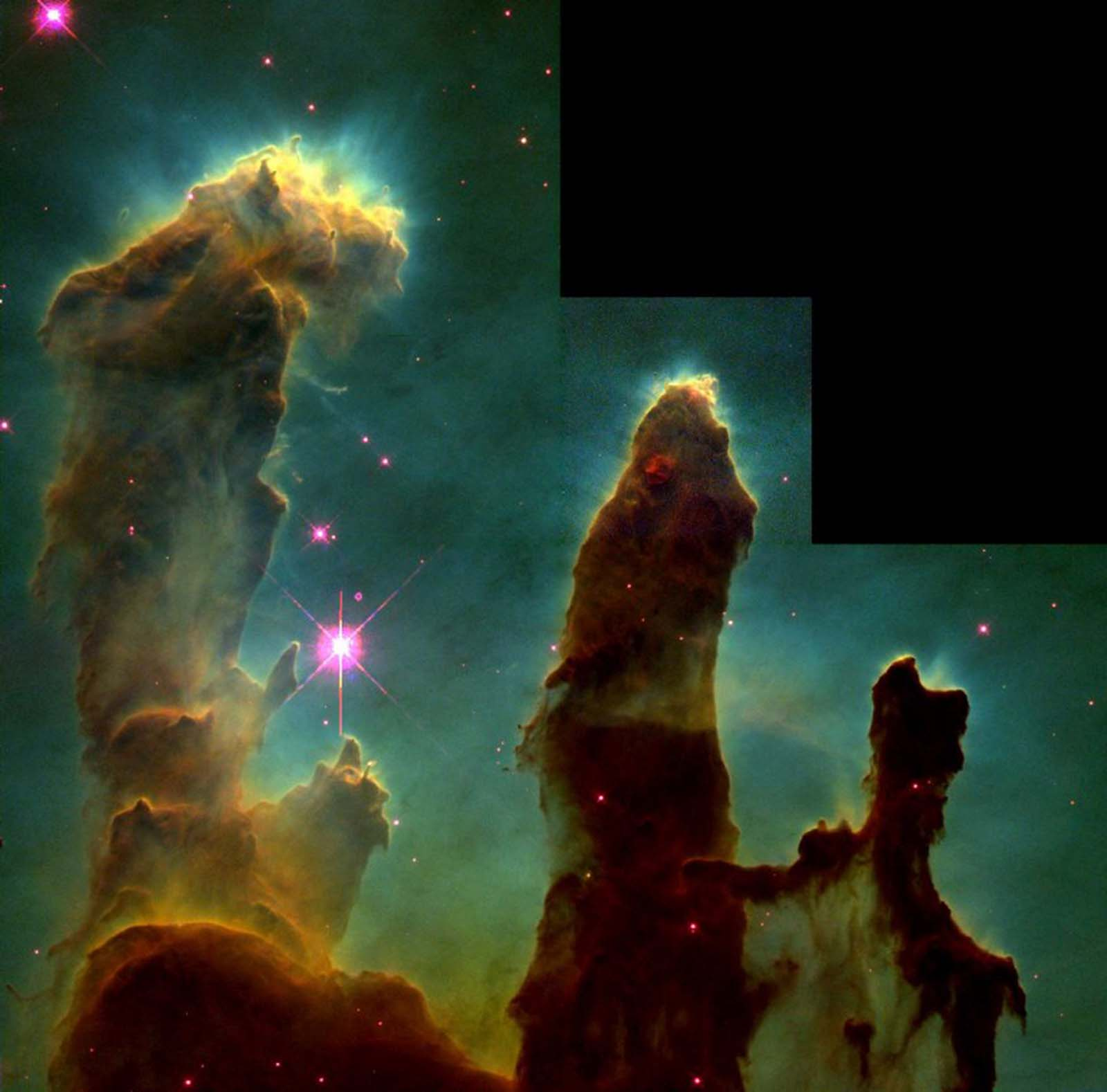
It shows towering, finger-like columns of interstellar gas and dust within the Eagle Nebula (Messier 16), located about 6,500–7,000 light-years from Earth in the constellation Serpens. The tallest of the three main pillars stretches roughly 4 light-years — nearly the distance from our Sun to the next nearest star.
The structures are regions of active star formation. Dense clumps of gas within the pillars collapse under gravity to form new stars, and the name reflects this — they’re literally nurseries where new stars are being born. The eerie, sculpted look of the columns comes from intense ultraviolet radiation and stellar winds from nearby young, hot stars, which erode the surrounding gas and dust while leaving denser, more resistant knots standing as the pillar-like shapes.
It was taken by astronomers Jeff Hester and Paul Scowen using Hubble’s Wide Field and Planetary Camera 2, and combines several exposures using different filters to highlight various elements (like hydrogen, oxygen, and sulfur), which is why the image has its distinctive, almost painterly color palette. It quickly became one of the most recognized and widely reproduced images in the history of astronomy, symbolizing both the beauty of the universe and the power of the Hubble telescope itself.
Some research has suggested that a shockwave from a supernova explosion may have already destroyed the pillars thousands of years ago — but because of the vast distance, the light showing their current (destroyed) state, if that’s the case, hasn’t reached Earth yet, meaning we’re seeing them as they were millennia ago. This remains a topic of some scientific debate.
In 2014, Hubble captured a sharper, higher-resolution version of the same scene for its 25th anniversary. NASA’s James Webb Space Telescope also captured striking infrared views of the pillars in 2022, revealing new details invisible in the original visible-light image.