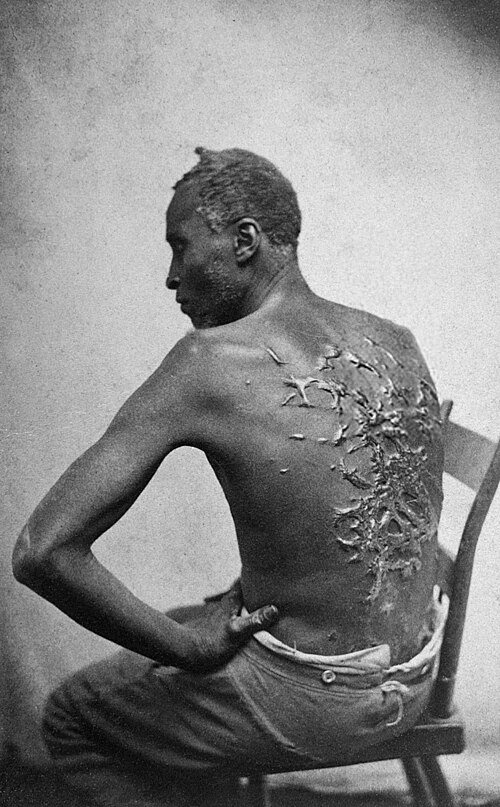
Peter (often referred as “Gordon”) was a enslavedd man who had escaped from a brutal cotton plantation in Mississippi owned by John and Bridget Lyons, where he had suffered a horrific whipping that left him near death.
To gain his freedom, Peter executed an incredible, death-defying escape over a period of 10 days, fleeing through 40 miles of treacherous Louisiana swamps. To prevent the plantation owner’s bloodhounds from tracking his scent, Peter carried onions in his pockets, rubbing them all over his body whenever he crossed a creek. He successfully reached the safety of a Union Army encampment in Baton Rouge, entirely exhausted and draped in rags.
During a routine mandatory medical examination before enlisting in the Union Army, Peter was ordered to strip off his shirt. His entire back was covered in a dense, crisscrossing web of massive, raised keloid scars—the permanent physical evidence of brutal, systemic torture.
At the time, many white Northern citizens and international observers (particularly in Great Britain and France) viewed the American Civil War through a purely political or economic lens, detached from the human reality of enslavement. “The Scourged Back” completely destroyed that detachment:
The image was printed onto small, mass-produced cardboard cards called cartes de visite. Abolitionists distributed millions of copies across the North and Europe.
- The Harper’s Weekly Feature: On July 4, 1863, Harper’s Weekly—the most widely read newspaper in the United States—published a woodcut reproduction of the photograph alongside an article detailing Peter’s harrowing escape.
The raw, undeniable proof of slavery’s cruelty galvanized public opinion. It deeply motivated Northern citizens to support the war effort and inspired thousands of free Black men and escaped slaves to enlist in the newly formed United States Colored Troops to fight for total abolition. Peter himself went on to serve bravely as a scout in the Union Army.