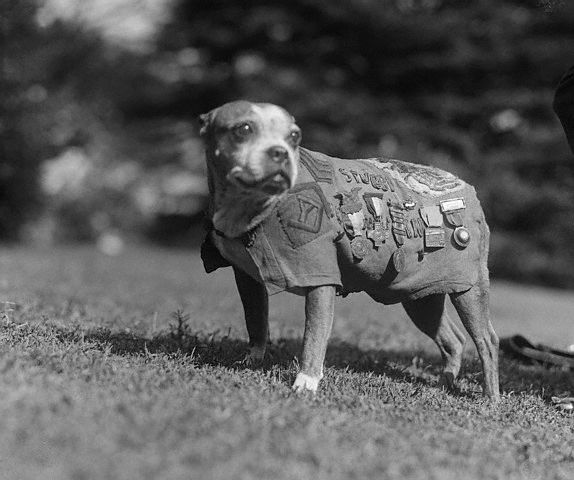
Sergeant Stubby was a stray Boston Terrier/Pit Bull mix who became a national hero and the unofficial mascot of America’s 102nd Infantry Regiment (26th “Yankee” Division).
In 1917, Stubby was a homeless pup wandering the campus of Yale University, where members of the 102nd Infantry were training. He was befriended by a young soldier named Private J. Robert Conroy. When it came time to deploy to Europe, Conroy hid Stubby in his overcoat and smuggled him aboard the troop ship bound for France. When the dog was discovered by a commanding officer, Stubby famously raised his right paw in a military salute—a trick Conroy had taught him—which so charmed the officer that Stubby was allowed to stay.
Stubby spent 18 months on the front lines in France, surviving 17 battles and 4 major offensives. His highly acute canine senses made him an invaluable asset to his regiment:
After surviving a mustard gas attack early in the war, Stubby became highly sensitive to the smell. When his regiment was hit by a surprise early-morning gas attack while the men were sleeping, Stubby ran through the trenches barking and biting at the soldiers, waking them up in time to put on their gas masks and saving countless lives
He learned to differentiate between English-speaking and German-speaking voices. He would navigate the perilous “No Man’s Land” to locate wounded American soldiers, barking until paramedics arrived, or comforting dying men by sitting beside them.
Stubby is credited with single-handedly capturing a German spy in the Argonne forest. The spy was mapping out American trenches when Stubby spotted him, bit him by the seat of his pants, and held him pinned to the ground until U.S. soldiers arrived. For this specific combat feat, Stubby was nominated and promoted to the rank of Sergeant, making him the first dog to hold rank in the U.S. Armed Forces.
The custom vest seen in the photograph was handcrafted for him by grateful French women in a liberated town, sewing his growing collection of medals onto it. Upon returning home, Stubby became an absolute celebrity.
He led victory parades across the United States, became a lifetime member of the American Legion, met three sitting U.S. presidents (Woodrow Wilson, Warren G. Harding, and Calvin Coolidge), and was personally awarded a gold hero’s medal by General John J. Pershing in 1921.