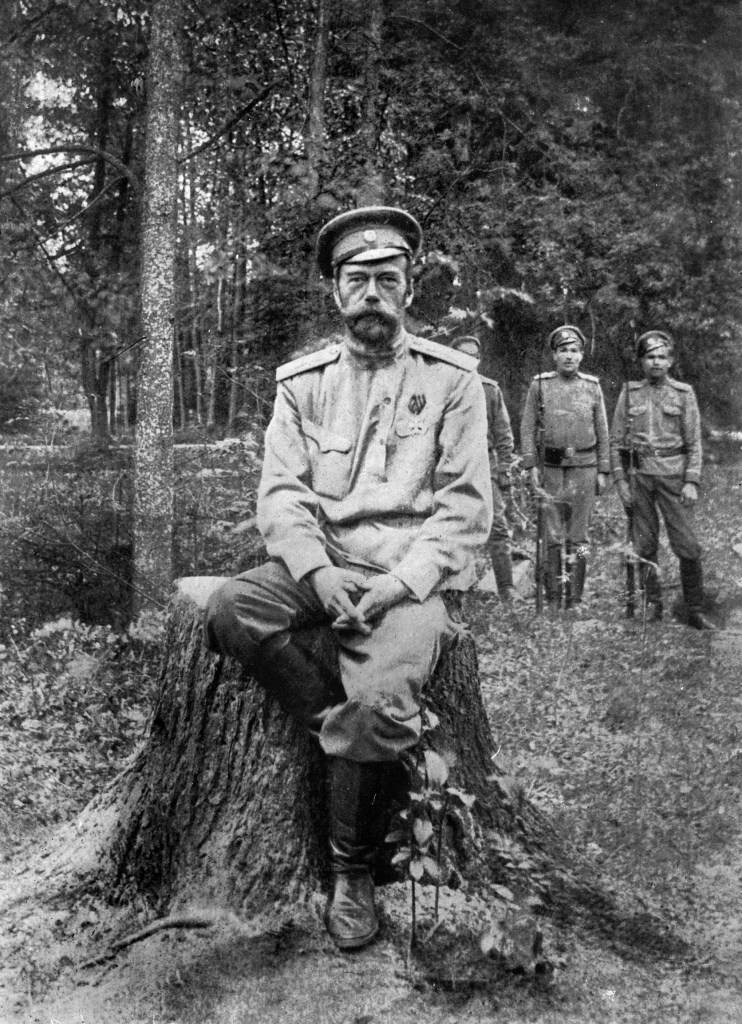
The 1917 photograph of Tsar Nicholas II sitting on a tree stump is the most famous visual symbol of the fall of the Russian Empire, capturing the recently abdicated monarch stripped of power and under armed guard. Distributed internationally in 1917–1918 through press agencies such as the Bain News Service (now preserved in the Library of Congress Prints and Photographs Division), it became the defining public portrait of “Citizen Romanov” in captivity.
ollowing his abdication on March 15, 1917 (March 2 Old Style) during the February Revolution, Nicholas II and his family were placed under house arrest by the Russian Provisional Government at the Alexander Palace in Tsarskoye Selo (near Petrograd / Saint Petersburg). Most archival records date this photograph to spring or summer 1917 in the wooded grounds of Alexander Park (though some agencies later misattributed it to his arrival in Tobolsk in August 1917).
During their five months at Tsarskoye Selo, Nicholas II and his family spent hours outdoors gardening, clearing brush, and sawing fallen trees for exercise and firewood under strict military surveillance.
Nicholas II sits alone with his legs crossed on the broad stump of a felled pine tree in a forest clearing. He wears a plain, unadorned Russian military field tunic (gymnasterka), peaked cap, riding breeches, and tall leather boots—notably stripped of all royal orders, medals, and imperial insignias.
His hands rest calmly on his knee, yet his face appears thin, weathered, and deeply somber as he gazes directly into the lens.
Standing just a few paces behind him to the right are three armed soldiers assigned to guard him, casually watching the deposed autocrat. Their relaxed yet ever-present stance underscores the total reversal of power: the former Supreme Commander of the Imperial Russian Army is now a prisoner in his own palace park.
Historians frequently highlight the stark contrast between the quiet, ordinary woodland setting and the rigid reality of armed confinement.
Because Western newspapers reproduced this specific portrait extensively in 1917 and again in July 1918 upon news of the Romanovs’ execution, it became embedded in public memory as “the last photo of Tsar Nicholas II”—even though private family snapshots continued to be taken in Tobolsk until April 1918.