Por su parte, la Convención para la Protección del Medio Ambiente Marino del Atlántico del Nordeste (OSPAR) (Paris; 1992, 1998)
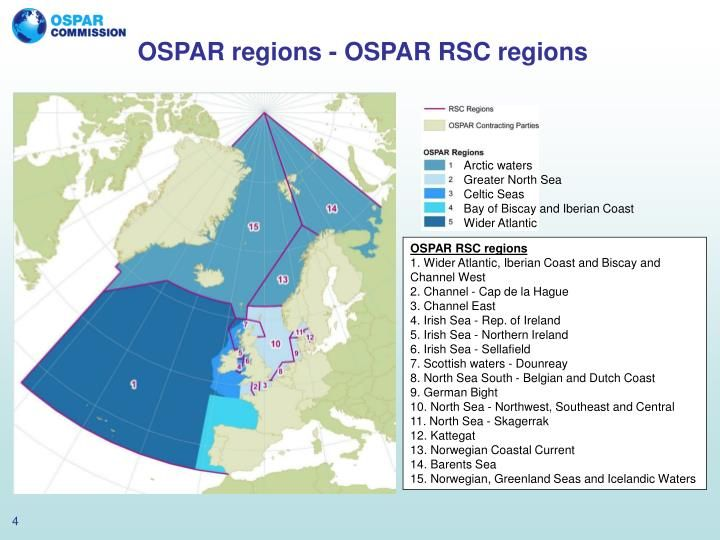
| Regiones | Cinco distintas, incluyendo ártico (I), Mar del Norte (II), Mar Céltico (III), Golfo de Vizcaya y Costas Ibéricas (IV), y Atlántico abierto (V), divididas a su vez en 15 subregiones (RSC). |
| Sistema de Anexos | I. Contaminación terrestre II. Vertidos e incineración III. Contaminación marítima IV. Evaluación de la calidad ambiental V. Patrimonio natural y biodiversidad |
| Estructura organizativa | - Partes Contratantes - Comisión OSPAR - Secretaría: administración diaria del Convenio y soporte técnico y logístico a la Comisión |
Cuenta con una red de áreas marinas protegidas (OSPAR MPAs), alunas de las cuales se encuentran en el Tratado de Protección de Áreas Más Allá de la Jurisdicción Nacional (BBNJ Agreement) (Región V. Mar abierto).
| Áreas marinas protegidas | BBNJ Agreement |
|---|---|
 |  |
La Convención para la Protección del Medio Ambiente Marino del Atlántico del Nordeste (OSPAR) (Paris; 1992, 1998)
Características
Sus principales características incluyen las siguientes:
Fusiona la Convención de Oslo (1972) sobre vertidos al mar y la Convención de París (1974) sobre contaminación marina de origen terrestre (de donde deriva su nombre).
En 1998 se adoptó un nuevo anexo sobre biodiversidad y ecosistemas para cubrir actividades humanas no contaminantes que también pueden afectar negativamente al mar.
-
Partes Contratantes: 15 gobiernos y la Unión Europea.
- Bélgica
- Dinamarca
- Finlandia
- Francia
- Alemania
- Irlanda
- Islandia
- Luxemburgo
- Países Bajos
- Noruega
- Portugal
- España
- Suecia
- Suiza
- Reino Unido
- Unión Europea
-
Su cumplimiento lo supervisa la Comisión OSPAR, formada por representantes de los gobiernos de las partes signatarias y por representantes de la Comisión Europea en nombre de la UE.
-
Las partes contratantes se reúnen cada año, y cada cinco años tiene lugar una reunión ministerial (la más reciente en Vigo, en junio de 2025).
Los cinco anexos
Área marítima: cinco regiones
OSPAR divide su zona marítima en cinco regiones: Región I – Aguas árticas; Región II – Gran Mar del Norte; Región III – Mares Célticos; Región IV – Golfo de Vizcaya y costa ibérica; y Región V – Atlántico abierto, que incluye zonas fuera de las aguas jurisdiccionales nacionales. Ospar
Principios rectores
La Comisión OSPAR basa sus decisiones y recomendaciones en principios como las Mejores Técnicas Disponibles (BAT) y las Mejores Prácticas Ambientales (BEP), incluida la tecnología limpia, además del principio de precaución y “quien contamina, paga”. DGRM
Estrategia vigente: NEAES 2030
- La Estrategia del Atlántico Nordeste 2030 (NEAES) se adoptó el 1 de octubre de 2021 en Cascais (Portugal) y fue modificada en la reunión ministerial de Vigo del 26 de junio de 2025. OSPAR Commission
- Se organiza en torno a cuatro temas: mares limpios; mares biológicamente diversos; mares productivos y usados de forma sostenible; y mares resilientes al cambio climático y la acidificación del océano, desarrollados mediante 12 objetivos estratégicos sobre eutrofización, sustancias peligrosas, sustancias radiactivas, basura marina y biodiversidad, entre otros. United NationsOSPAR Commission
- Busca hacer frente al “triple reto” del océano: la pérdida de biodiversidad, la contaminación —incluida la basura marina— y el cambio climático. OSPAR Commission
Evaluación y áreas protegidas
- El Informe de Estado de Calidad (QSR) de 2023 es la evaluación más autorizada de OSPAR sobre el estado del medio marino del Atlántico Nordeste. UNEP
- Desde 2005, las Partes Contratantes han designado espacios en la Red OSPAR de Áreas Marinas Protegidas dentro de sus aguas nacionales. Ospar
En conjunto, OSPAR combina un marco legal vinculante (los anexos y decisiones) con una estrategia política renovable (la NEAES) para abordar tanto la contaminación clásica como los retos más recientes: biodiversidad, cambio climático y basura marina.
Las principales características son las siguientes
-
Conservación del Atlántico Nor-este: 5 regiones y 15 subregiones (RSC)
- Región I: Ártico
- Región II: Mar del Norte
- Región III: Mar Céltico
- Región IV: Golfo de Vizcaya y Aguas Ibéricas (Costa Ibérica)
- Región V: Atlántico Abierto
Se basa en un sistema de 5 Anexos:
- I. Prevención y Eliminación de la Contaminación por Fuentes Terrestres
- II. Prevención y Eliminación de la Contaminación por Vertimiento o Incineración
- III. Prevención y Eliminación de la Contaminación por Fuentes Marítimas
- IV. Evaluación de la Calidad del Medio Ambiente Marino
- V. Protección y Conservación de Ecosistemas y Diversidad Biológica del Área Marítima
La estructura organizativa cuenta con las Partes Contratantes, la Comisión OSPAR (órgano de gestión), y la Secretaría. La Comisión se compone de lo siguiente:
- Partes Contratantes
- Comisión OSPAR
| Grupos de Coordinación y Apoyo | - Grupo de Coordinación (CoG): facilita la comunicación entre los diferentes comités - Jefes de Delegación (HoD): Jefes de delegación de los países miembros - Grupo de Juristas y Lingüístas (JL): aspectos legales y de traducción - Comité de Presidentes y Vicepresidentes (CVC): coordina las actividades |
| Comités Principales | - Comité de Sustancias Peligrosas y Eutrofización (HASEC) - Comité de Industria Offshore (OIC): petróleo, gas, energías renovables… - Comité de Sustancias Radioactivas (RSC) - Comité de Biodiversidad (BDC) - Comité de Impacto Ambiental de las Actividades Humanas (EIHA) |
- Secretaría
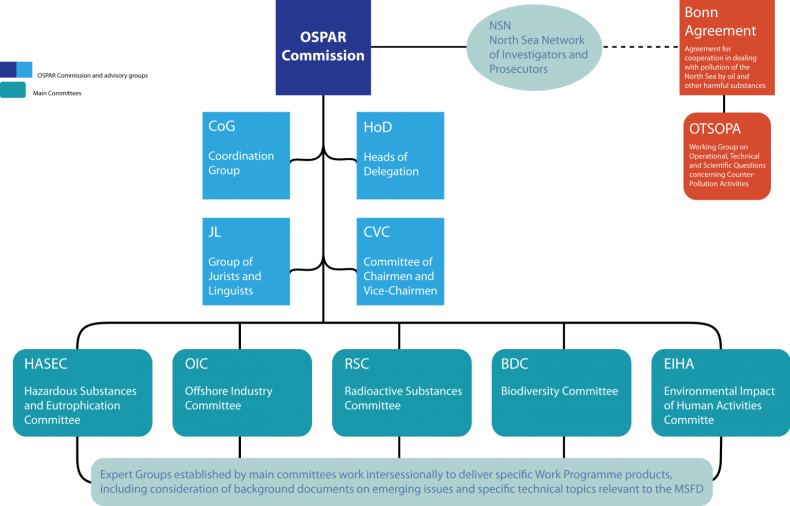
Estructura organizativa del Convenio OSPAR. Fuente: Página web del Convenio OSPAR
Evolución
Respecto a la evolución:
- Convenio de Oslo (1972), sobre la contaminación por vertidos desde barcos y aeronaves
- Convenio de París (1974), que regulaba la contaminación marina de origen terrestre
- Convenio para la Protección del Medio Ambiente Marino del Atlántico Nordeste (Convenio OSPAR) (1992)
- Entrada en vigor del Convenio OSPAR (1998):
- Primera cumbre ministerial y adopción del Anexo V (1998): para incorporar la protección de la biodiversidad y los ecosistemas del Atlántico del Noreste, ampliando el ámbito de cooperación para incluir todas las actividades humanas que pudieran afectar al medio marino
- Enmiendas a los Anexos II y III (2007): para permitir el almacenamiento de dióxido de carbono en formaciones geológicas bajo el lecho marino (carbon capture and storage, CCS)
- Ampliación del área marítima (2025):
- Estrategia para el Medio Ambiente del Atlántico Nordeste 2030 (NEAES 2030)
- Declaración Ministerial de Vigo:
Los principios:
| Principios | - Precaución - “Quien contamina, paga” - Mejores técnicas disponibles y mejores prácticas ambientales (incluyendo tecnología limpia) - Prevención - Desarrollo sostenible (incluidas aproximaciones de economía circular) - Corrección de la contaminación en fuente |
| Aproximaciones | - Gestión adaptativa - Fuente al mar - Regional - Basada en riesgo - Conocimiento y ciencia |
Se establecieron 12 objetivos estratégicos:
| Categoría | Objetivos estratégicos |
|---|---|
| Calidad de las aguas | 1. Eutrofización 2. Sustancias peligrosas 3. Sustancias radioactivas 4. Basuras marinas (incluidos micro-plásticos) |
| Biodiversidad | 5. Biodiversidad marina: ecosistemas y sus servicios, especies y hábitats 6. Restauración de hábitats: función ecológica, cambio climático, acidificación del océano 7. Uso sostenible: 8. Contaminación acústica submarina 9. Lecho marino |
| Cambio climático y acidificación | 10. Sensibilización: monitorización, análisis, y comunicación de efectos 11. Adaptación: facilitación al considerar presiones adicionales al desarrollar programas, acciones y medidas 12. Mitigación: contribución a los esfuerzos globales, incluyendo sumidero de carbono |
Estos fueron desarrollados por objetivos operaciones:
| Objetivos estratégicos | Objetivos operacionales |
|---|---|
| 1 | 1. By 2022 OSPAR will implement an automated eutrophication assessment tool to deliver harmonised and transparent assessments for OSPAR and the Marine Strategy Framework Directive and to provide support for the development of the SDG 14.1.1 Index of Coastal Eutrophication in 2025 S1.O2: By 2022 OSPAR will determine the maximum inputs of nutrients for relevant assessment areas which prevent deterioration and enable the achievement of non-problem area status throughout the North-East Atlantic. S1.O3: By 2024 OSPAR will identify and quantify relevant sources, including transboundary transport, and agree nutrient reduction needs for each Contracting Party to stay at or below the maximum input levels, reporting on progress towards these in 2025 and regularly thereafter. S1.O4: By 2028 OSPAR will ensure that sufficient measures are taken to achieve the necessary input reductions to prevent coastal and offshore eutrophication in the North-East Atlantic, working where appropriate with national and international organisations and authorities concerned with managing nutrient emissions, discharges and losses. S1.O5: By 2030 OSPAR will ensure that nutrient reduction targets and measures are sufficient to avoid adverse eutrophication effects in a changing climate. S1.O6: By 2030 OSPAR will develop and implement a regional approach to applying nature-based solutions to reinstate and safeguard the natural capacity of the ecosystem to sequester nutrients through conservation and restoration of estuarine, coastal and marine habitats, where this is practicable. |
| 2 | S2.O1: By 2022 OSPAR will introduce a revised approach to managing the OSPAR Lists of Chemicals for Priority Action and Substances of Possible Concern (LCPA and LSPC). By 2022 and regularly thereafter, OSPAR will identify contaminants of emerging concern for the marine environment and prioritise them for action, including promoting and where necessary supplementing measures under relevant EU legislation and international organisations. S2.O2: OSPAR will develop and identify marine-relevant assessment criteria for hazardous substances, for use in the Quality Status Report 2023 and subsequently further develop these, including for emerging contaminants, working closely with relevant experts, particularly in the Working Group Chemicals under the Water Framework Directive Common Implementation Strategy. S2.O3: By 2027 OSPAR will ensure that measures to eliminate discharges, emissions and losses of hazardous substances are in place to achieve or maintain good environmental status for hazardous substances, including through working regularly with other organisations. S2.O4: By 2026 OSPAR will further develop the Harmonised Mandatory Control System for the use and discharge of offshore chemicals to improve coherence with other relevant international requirements such as the EU REACH Regulation16 and the Biocidal Products Regulation |
| 3 | S3.O1: On an ongoing basis OSPAR will further prevent, progressively reduce or, where that is not practicable, minimise discharges of radioactive substances through the application of Best Available Techniques (BAT), taking into account technical feasibility, radiological impact and legitimate uses of the sea. S3.O2: By 2025 OSPAR will identify and consider any obstacles in achieving further reductions in environmental concentrations of radioactive substances in the marine environment and examine possible solutions where appropriate. S3.O3: By 2025 OSPAR will identify the different types of loss of radioactive substances that may contribute to pollution of the marine environment. By 2027 OSPAR will determine if any additional measures are required to prevent such pollution, to the extent that such pollution is not already the subject of effective measures agreed by other international organisations or prescribed by other international conventions. S3.O4: By 2028 OSPAR will, following the outcome of the Quality Status report 2023, address, where appropriate, any uncertainties by reviewing and updating methodologies to better determine the possible impact of releases, emissions and losses of radioactive substances on marine ecosystems |
| 4 | S4.O1: By 2022 OSPAR will agree an updated Regional Action Plan on Marine Litter including a set of prioritised “SMART” objectives to address new and emerging issues and to reduce the impacts of those items causing most harm to the marine environment. S4.O2: By 2023 OSPAR will improve the evidence base on harm in relation to marine litter with the aim of developing and agreeing actions and measures to reduce harm by 2025. S4.O3: By 2025 OSPAR will reduce by at least 50%18 the prevalence of the most commonly found single-use plastic items and of maritime-related plastic items on beaches in order to contribute to the achievement of relevant regional and EU threshold values building upon requirements for EU Member States in the EU Single Use Plastics Directive (Directive 2019/904), and by at least 75%19 by 2030.20 S4.O4: By 2023 OSPAR will develop additional regionally coordinated quantitative reduction targets for all marine litter on beaches, and as soon as possible for other relevant environmental compartments, taking account of relevant regional and EU threshold values. S4.O5: By 2027 OSPAR will adopt programmes and measures to control and, where appropriate, phase out plastic from materials placed at sea for the purposes of marine infrastructure developments. S4.O6: By 2027 OSPAR will develop measures to control, and where possible, phase out discharges of plastic substances, including microplastics, contained in chemicals from offshore sources. S4.O7: By 2025 OSPAR will develop approaches to prevent and reduce riverine marine litter inputs in cooperation with the relevant international river or river basin commissions, and other appropriate authorities and organisations. S4.O8: By 2025 OSPAR will develop and implement measures to substantially reduce marine litter from fishing and aquaculture gear, in collaboration with those sectors, as appropriate, and by 2027 will determine the need for, and where appropriate adopt, targets or other actions for the separate collection of end-of-life fishing and aquaculture gear coherent with relevant EU directives and the update of the OSPAR Regional Action Plan on Marine Litter. |
| 5 | S5.O1: By 2030 OSPAR will further develop its network of marine protected areas (MPAs) and other effective area-based conservation measures (OECMs)21 to cover at least 30%22 of the OSPAR maritime area to ensure it is representative, ecologically coherent and effectively managed to achieve its conservation objectives. S5.O2: By 2022 OSPAR will identify barriers to the effective management of MPAs, and by 2026 take steps to address them appropriately to enable all OSPAR MPAs to achieve their conservation objectives. S5.O3: By 2024, OSPAR will establish a mechanism to provide that where Contracting Parties are authorising human activities under their jurisdiction or control that may conflict with the conservation objectives of OSPAR MPAs in the ABNJ, these activities are subjected to an Environmental Impact Assessment (EIA) or Strategic Environmental Assessment (SEA). S5.O4: By 2025 at the latest OSPAR will take appropriate actions to prevent or reduce pressures to enable the recovery of marine species and benthic and pelagic habitats in order to reach and maintain good environmental status as reflected in relevant OSPAR status assessments, with action by 2023 to halt the decline of marine birds. S5.O5: By 2025 OSPAR will have implemented all agreed measures to enable the recovery of OSPAR Listed threatened and/or declining species and habitats and will take additional measures as needed. S5.O6: Where the knowledge base is insufficient to achieve OSPAR’s biodiversity objectives, OSPAR will take action to improve regional coordination for collection and sharing of data, information and knowledge, with elasmobranchs as a priority by 2023. |
| 6 | S6.O1: By 2023 OSPAR will identify habitats suitable for restoration, and develop a common knowledge base on the most appropriate and effective methods for restoration of degraded habitats. S6.02: By 2025 OSPAR will develop a regional approach, including relevant qualitative and/or quantitative targets for restoration of degraded habitats suitable for restoration, and will then implement actions to achieve the targets as appropriate. |
| 7 | S7.O1: By 2028 OSPAR will further develop methods for the analysis of cumulative effects in the marine ecosystems of the North-East Atlantic, taking into account relevant spatial and temporal information on human activities, pressures, sensitive receptors and habitats, and use the results to inform the establishment of measures and actions to prevent, reduce or otherwise manage impacts. S7.O2: By 2025 OSPAR will develop a coordinated management approach to ensure the number of non-indigenous species introduced via human activity is minimised and where possible reduced to zero. S7.O3 By 2025 OSPAR will start accounting for ecosystem services and natural capital by making maximum use of existing frameworks in order to recognise, assess and consistently account for human activities and their consequences in the implementation of ecosystem-based management. S7.O4: By 2023 OSPAR will assess, review and potentially revise the OSPAR criteria, guidelines and procedures relating to the dumping of wastes or other matter and to the placement of matter. S7.O5: By 2024 OSPAR will review the risks from new, emerging and increasing pressures on the marine environment, taking account of OSPAR’s Quality Status Report 2023, and prioritise them for action and the adoption of measures where necessary. S7.O6: OSPAR will work with relevant competent authorities and other stakeholders to minimise, and where possible eliminate, incidental by-catch of marine mammals, birds, turtles and fish so that it does not represent a threat to the protection and conservation of these species and will work towards strengthening the evidence base concerning incidental by-catch by 2025. S7.O7: OSPAR will continue to develop work on the topics identified under S7.O5 (including offshore renewable energy, aquaculture, geoengineering, shipping, rocket launches and deep sea mining) and, where appropriate, by 2030 take action to reduce their impact on the marine environment, while fully respecting and not undermining relevant legal instruments and frameworks already in place. |
| 8 | S8.O1: By 2025 OSPAR will agree a regional action plan setting out a series of national and collective actions and, as appropriate, OSPAR measures to reduce noise pollution. S8.O2: By 2022 OSPAR will develop and implement a coordinated monitoring and modelling programme for continuous sound to support an assessment of anthropogenic underwater noise in the OSPAR maritime area. |
| 9 | S9.O1: By 2023 OSPAR will deliver a quantitative evidence base on pressures from human activities causing physical loss and disturbance to seabed habitats. On this basis, OSPAR will address and, where possible, reduce these pressures from human activities within its competence and regularly engage with other competent authorities with a view to reducing these pressures within their respective areas of competence in order to help achieve or maintain good environmental status. S9.O2: By 2023 and 2028 OSPAR will review and, if appropriate, amend the categories of disused offshore installations where derogations may be considered under OSPAR Decision 98/3 on the Disposal of Disused Offshore Installations, aiming to reduce the scope of possible derogations. The review will be based, inter alia, on the advancement of decommissioning technologies and on the best available scientific knowledge. S9.O3: By 2023 OSPAR will agree on an approach and on actions to promote and advance decommissioning technologies under the framework of Decision 98/3 with the aim of reducing the scope of possible derogations. S9.O4: By 2027 OSPAR will develop an updated approach on decommissioning of offshore renewable energy installations. |
| 10 | S10.O1: By 2025 OSPAR will implement a coordinated long-term monitoring programme for ocean acidification variables. S10.O2: By 2023 OSPAR will develop assessments of ocean acidification and climate change and will take the impacts of ocean acidification and climate change into account in relevant OSPAR indicators and assessments. S10.O3: In 2023, and every 6 years thereafter, OSPAR will assess the current and projected impacts of climate change and ocean acidification on the OSPAR maritime area and its uses, to inform the development of national and international actions. |
| 11 | S11.O1: By 2025 OSPAR will develop a coordinated management approach to strengthening ecosystem resilience, including to the consequences of climate change and ocean acidification. S11.O2: By 2023, and every six years thereafter, OSPAR will assess at a regional scale the OSPAR network of marine protected areas in respect of the resilience of marine biodiversity to climate change, with the aim of ensuring that the network provides a good representation of species and habitats and that its spatial design and management regime remains relevant. S11.O3: From 2021 OSPAR will ensure that revisions to the OSPAR list of threatened and/or declining species and habitats and status assessments take account of any relevant impacts of climate change and ocean acidification. S11.O4: From 2021 OSPAR will consider the additional pressures from climate change and ocean acidification both now and under future climate conditions in its regular review of measures and actions and update them as appropriate. |
| 12 | S12.O1: By 2025 OSPAR will develop a regional approach to applying nature-based solutions for carbon storage and implement specific measures to protect and restore relevant carbon sequestration and storage habitats, such as seagrass beds, kelp forests and saltmarshes. S12.O2: By 2025 OSPAR will take nature-based carbon storage into account when reviewing the criteria for the designation of marine protected areas, and reviewing the OSPAR List of threatened and/or declining species and habitats. S12.03: By 2027 OSPAR will review the results of monitoring that is undertaken in relation to carbon dioxide storage to assess whether the monitoring techniques deployed are adequate to demonstrate that carbon dioxide streams are retained permanently in the storage complex. By 2028 OSPAR will evaluate the effectiveness of OSPARmeasures to ensure that carbon dioxide streams are retained permanently in the storage complex and will not lead to any significant adverse consequences for the marine environment, human health and other legitimate uses of the maritime area. S12.O4: By 2023 OSPAR will develop common principles and by 2027 develop guidance to promote and facilitate sustainable development and scaling up of offshore renewable energy in a way that cumulative environmental impacts are minimised and in line with the ecosystem-based approach |
| Transversal (SX) | SX.O1: By 2027 OSPAR will implement the regional coordination requirements arising from Commission Decision (EU) 2017/84823 for those Contracting Parties that are EU Member States, including regional lists of elements, aggregation and assessment methods and threshold values for the North-East Atlantic region or its sub-regions. SX.O2: By 2024 OSPAR will initiate discussions on the development of a practical approach for regional-scale ecosystem- based management, including through the ‘Collective Arrangement24’ and in cooperation with fisheries management bodies and other competent organisations, in order to strengthen ecosystem resilience to climate change and to safeguard the marine environment, its biodiversity and ecosystem services. SX.O3: By 2027 OSPAR will review the extent to which current OSPAR structures and ways of working are effective in implementing the OSPAR Convention and delivering the NEAES 2030 and make recommendations for improvement as necessary. |
Aplicación a la conservación de los hábitats y especies marinas, así como a la gestión de las actividades humanas
Aplicación en España
En España, se aplica a las demarcaciones marinas noratlántica y sudatlántica.

Red de Áreas Marinas Protegidas OSPAR. Fuente: Ministerio con competencia en medio ambiente