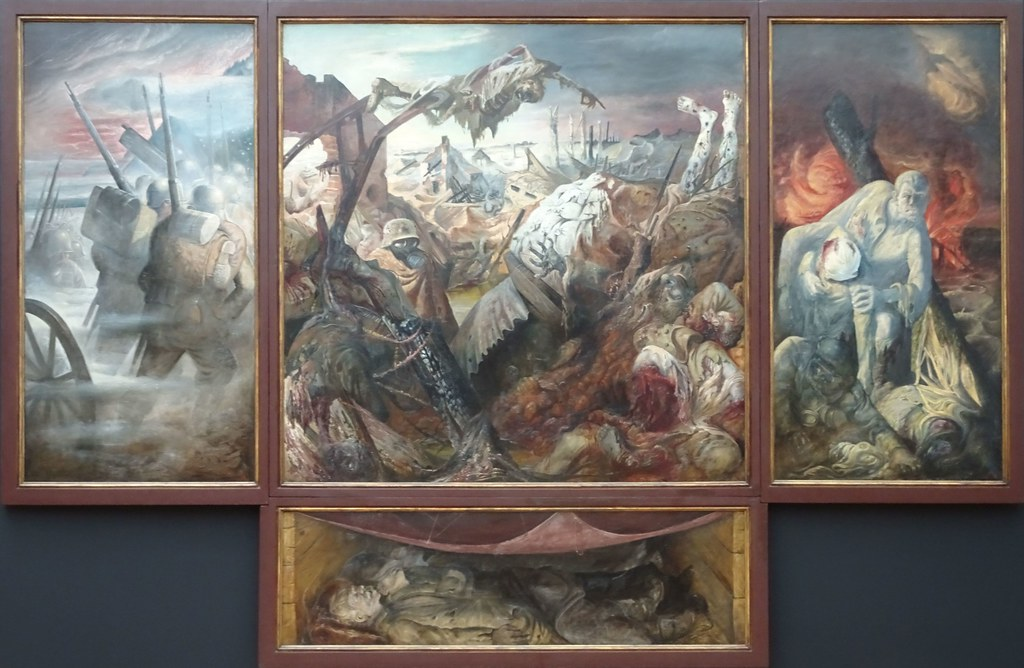
Dix created these masterpieces to purge his own recurring nightmares after surviving over three years as a machine-gunner on the front lines of the First World War.
This monumental oil painting is structured like a traditional, religious winged altarpiece, consisting of three main panels (a triptych) and a lower base panel (a predela). It is preserved as a crown jewel of the Galerie Neue Meister in Dresden, Germany.
-
Left Panel: Depicts a column of heavily geared German soldiers marching into the dense morning mist toward the front lines. Their faces are obscured; they march away from the viewer into almost certain death.
-
Central Panel: Portrays the absolute devastation of the battlefield following heavy artillery fire. It is an apocalyptic wasteland littered with decomposing corpses, trenches, and a soldier wearing a gas mask. Hovering above, a dead body caught in a twisted iron girder points downward like a haunting index finger, subverting classic crucifixion paintings.
-
Right Panel: Documents the rescue of the wounded. The soldier crawling through the ruins while dragging an injured comrade to safety is a self-portrait of Otto Dix.
-
The Predela (Lower Panel): Displays soldiers lying side-by-side in a cramped bunker. They look asleep, but they structurally mirror historical paintings of Christ dead in the tomb, symbolizing a mass grave.
Otto Dix’s’ goal was to expose the raw, unvarnished truth of industrial warfare and hold a mirror up to society.
He summed up his motivation with a sharp statement:
“War is something so bestial: hunger, lice, fear… I had to paint it to get rid of it.”