Bea Johnson (1974-today) is a French-American environmental activist, speaker, and author who is widely recognized as the pioneer and mother of the global zero-waste lifestyle movement.
Before becoming the “Priestess of Waste-Free Living” (as named by The New York Times), Bea and her family lived a typical American suburban lifestyle with a massive house and two large weekly bins of trash.
The catalyst happened when they decided to downsize and move closer to the city. They placed 80% of their belongings in storage for a year, only to realize they didn’t miss a single thing. This triggered a shift toward voluntary simplicity, which eventually led them to question their waste generation and ultimately discover the “zero waste” concept.
40% Financial Savings: A common misconception is that zero-waste living is expensive. However, Johnson revealed that her family saved roughly 40% of their overall household budget. They achieved this by drastically reducing consumption, buying food entirely in bulk without paying for packaging, and purchasing everything else secondhand.
By eliminating heavily packaged, processed foods and harsh commercial chemicals, the family noticed immediate health improvements, such as the disappearance of chronic sinus infections.
Johnson’s household is famous for replacing single-use items with creative, long-term alternatives:
The Perimeter Rule: When grocery shopping, she strictly buys from the outer edges of the grocery store where whole, fresh, unpackaged foods reside. She famously brings cloth bags made from old sheets and glass jars to meat and cheese counters.
Ultra-Minimal Wardrobe: Johnson personally maintains an incredibly tiny 15-piece capsule wardrobe that allows her to mix and match multiple outfits.
She creates her own zero-waste cosmetics, using bulk organic cocoa powder as cheek blush/bronzer and a simple four-ingredient recipe for homemade mascara.
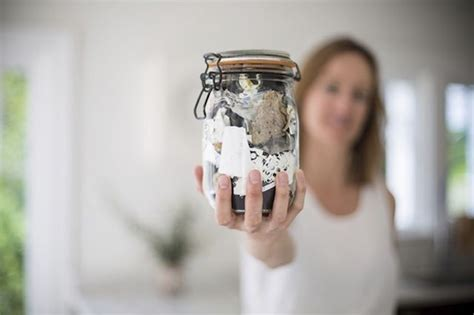
The Trash Jar: Since 2008, Johnson and her family have famously practiced a waste-free lifestyle, reducing their household garbage to fit into a single small glass jar (about a pint or quart) per year.
She wrote the book Zero Waste Home, which has been translated into dozens of languages and became a #1 Amazon bestseller in its category and has been translated to more than 25 languages!
She has delivered hundreds of talks across more than 70 countries and six continents, inspiring individuals, communities, and major corporations like Google and the United Nations.
Bea Johnson is a French activist known worldwide as a pioneer of the “Zero Waste” movement by her blog Zero Waste Home.
Bea Johnson is a French-American author and speaker, widely recognized as one of the pioneering and most influential figures in the modern “zero waste” lifestyle movement.
Johnson was born in France and moved to the United States, where she and her family (her husband and two sons) began drastically reducing the amount of waste they generated in their everyday life. She’s known for popularizing the concept of the “5 R’s” as a practical framework for the zero waste lifestyle:
Bea popularized a simple, strict framework for sustainable living known as the 5Rs, which must be followed in this exact order:
- Refuse: what you don’t need
- Reduce what you do need
- Reuse
- Recycle — and only as a last resort
- Rot (compost) the rest.
This order of priorities is central to her approach: first avoid generating waste in the first place, and recycle only when there’s no other option left.
In 2013, she published her best-known book, “Zero Waste Home,” in which she documents her family’s experience reducing their waste generation to extremely low levels — her most frequently cited example is that, for years, her family of four reportedly fit an entire year’s worth of non-recyclable, non-compostable trash into a single small mason jar.
The book became an international bestseller and has been translated into multiple languages, helping bring the zero waste concept from a niche environmental practice into mainstream popular awareness. Johnson is often credited as one of the key figures who helped launch the zero waste movement as a recognizable lifestyle trend, well before “zero waste” became a common term in sustainability and lifestyle media.
Beyond the book, Johnson has become a sought-after public speaker on sustainability and waste reduction, giving talks (including a well-known TEDx talk) and consulting with individuals, businesses, and even municipalities on reducing waste.
Like many figures who become the public face of a lifestyle movement, Johnson has faced some criticism — including questions about how replicable her specific lifestyle is for people with different economic means, family situations, or access to bulk-buying stores and zero-waste infrastructure, as well as broader debates about whether individual consumer choices can meaningfully address waste at the systemic level compared to industrial and corporate practices.
Her approach is based on five fundamental principles known as the “5 R’s”:
- Refuse
- Reduce
- Reuse
- Recycle
- Rot (Compost)
The waste she produced in a jar could be stored in a glass jar.
She wrote the book “Zero Waste Home: The Ultimate Guide to Simplifying Your Life by Reducing Your Waste” (2013), where she documents how her family of four managed to reduce their annual waste to less than a liter, contained in a small glass jar. It has been translated in 28 languages
She published the book “Zero Waste Home: The Ultimate Guide to Simplifying Your Life by Reducing Your Waste” in 2013, which has been translated to 28 languages.
Her philosophy includes a minimalist lifestyle.
Bea has given lectures around the world, has been a consultant for companies and governments, and maintains a blog where she shares practical tips for adopting this lifestyle.
Her work has inspired thousands of people to rethink their consumption habits and has significantly contributed to popularizing the concept of zero waste living globally.
El sitio oficial menciona que su trabajo ha inspirado no solo a particulares, sino también a la apertura de tiendas sin empaques, al diseño de productos reutilizables, al lanzamiento de organizaciones, e incluso a grandes corporaciones que ahora ofrecen alternativas al plástico de un solo uso.