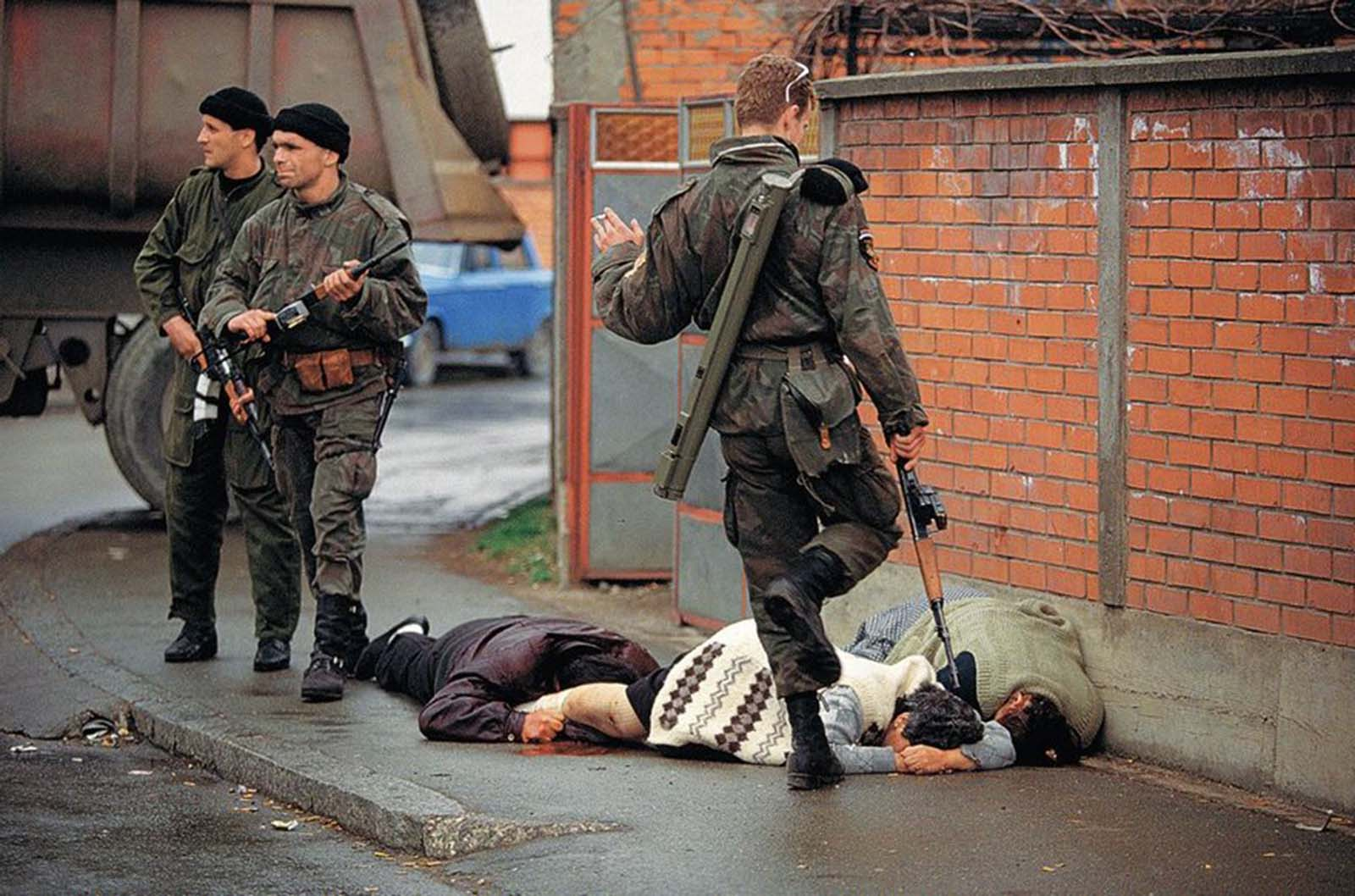
In April 1992, the town of Bijeljina was targeted by the Serb Volunteer Guard, a notorious paramilitary unit popularly known as Arkan’s Tigers, led by Željko Ražnatović (“Arkan”). The unit entered the town to forcefully displace and eliminate the non-Serb population.
Haviv had managed to gain permission to shadow the unit, mistakenly assumed by the soldiers to be a sympathetic journalist. Standing on a street corner, Haviv witnessed a local Muslim butcher, Hajrush Ziberi, along with his wife and sister-in-law, being dragged out of a cellar and shot by the paramilitaries. As the women lay dying on the ground, a young Serb soldier with sunglasses perched on his head casually walked up, a burning cigarette dangling from his left hand, and kicked the skull of one of the women.
It provided the international community with undeniable visual evidence that the conflict was not a standard military engagement, but a systematic campaign of terror directed against civilians.
Decades later, Haviv’s photographs were heavily utilized as key prosecutorial evidence by the International Criminal Tribunal for the former Yugoslavia (ICTY) in The Hague to convict top military and political leaders of war crimes and crimes against humanity.