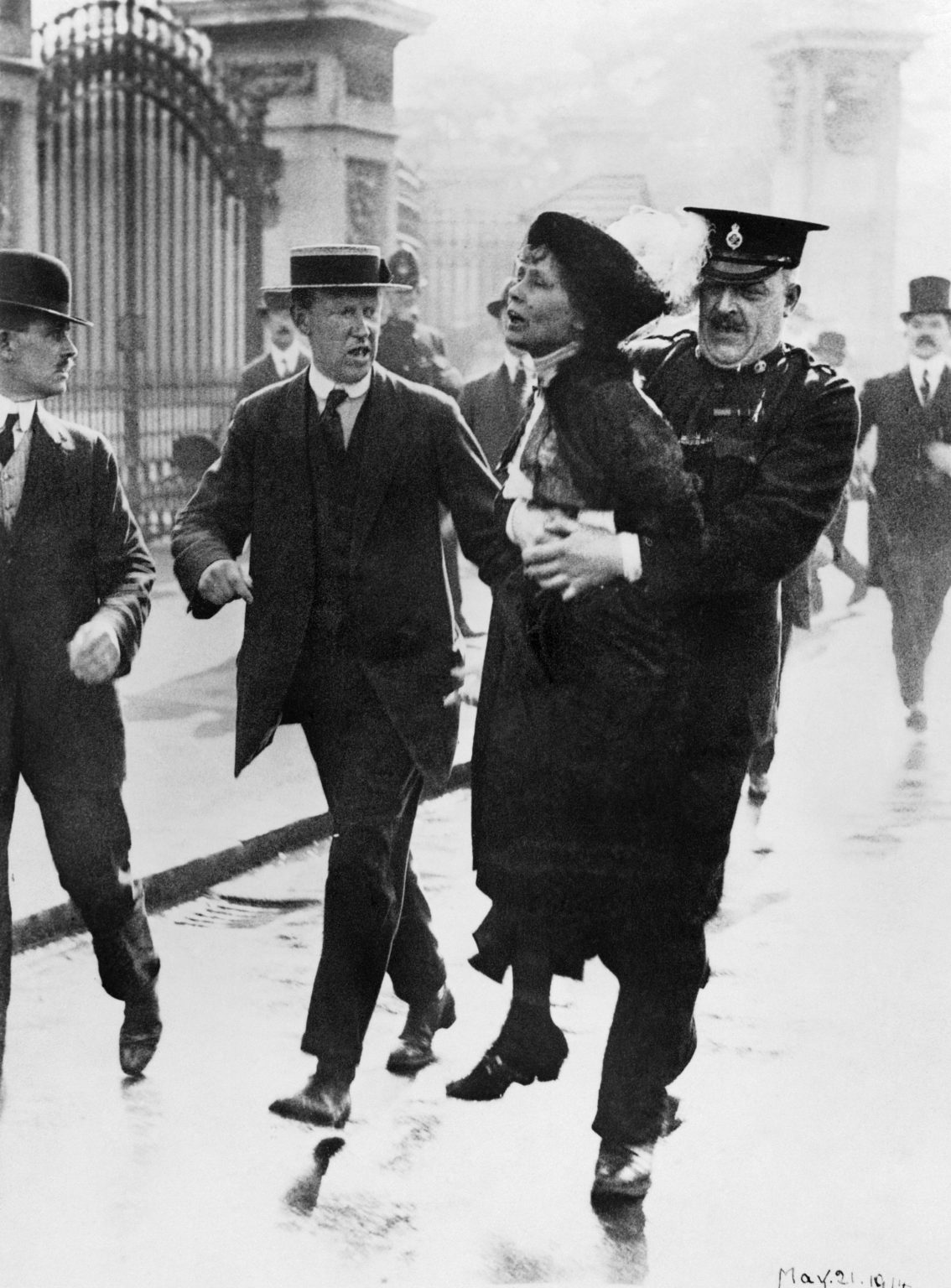
This refers to a famous photograph capturing the arrest of suffragette leader Emmeline Pankhurst outside Buckingham Palace on May 21, 1914.
By 1914, Pankhurst was the leader of the Women’s Social and Political Union (WSPU), the militant wing of the British suffrage movement, known for its slogan “Deeds, not words.” The WSPU had escalated from peaceful protest to civil disobedience and property destruction — window-smashing, arson, and other acts — as a strategy to force the government to grant women the vote, after decades of more moderate campaigning had failed to produce results.
On this occasion, Pankhurst was leading a WSPU deputation attempting to petition King George V directly at Buckingham Palace, seeking to appeal to the monarch over the head of Parliament. Police intercepted her before she could reach the palace gates. The resulting photograph shows her being physically seized and carried off by a police officer (Chief Inspector Rolfe), her feet lifted off the ground — a dramatic, almost violent-looking image of a middle-aged, well-dressed woman being manhandled by the state.
This wasn’t an isolated incident — Pankhurst was arrested many times over the course of her activism (by some counts more than a dozen times) under the “Cat and Mouse Act,” which allowed authorities to release hunger-striking suffragette prisoners when they became weak, then re-arrest them once they’d recovered. The photograph of this particular arrest became one of the enduring visual symbols of the suffrage movement — capturing the stark power imbalance between the state and the women fighting for basic political rights, and the lengths to which authorities went to suppress the movement.
The outbreak of World War I just a few months later, in August 1914, led Pankhurst to suspend militant WSPU activity in favor of supporting the war effort. Partly in recognition of women’s wartime contributions, the Representation of the People Act 1918 granted voting rights to women over 30 who met certain property qualifications — a partial victory. Full and equal voting rights for women in Britain wouldn’t come until 1928, shortly before Pankhurst’s death that same year.