“Raising the Flag on Iwo Jima” is one of the most iconic and widely reproduced photographs in history, taken by Associated Press photographer Joe Rosenthal on February 23, 1945.
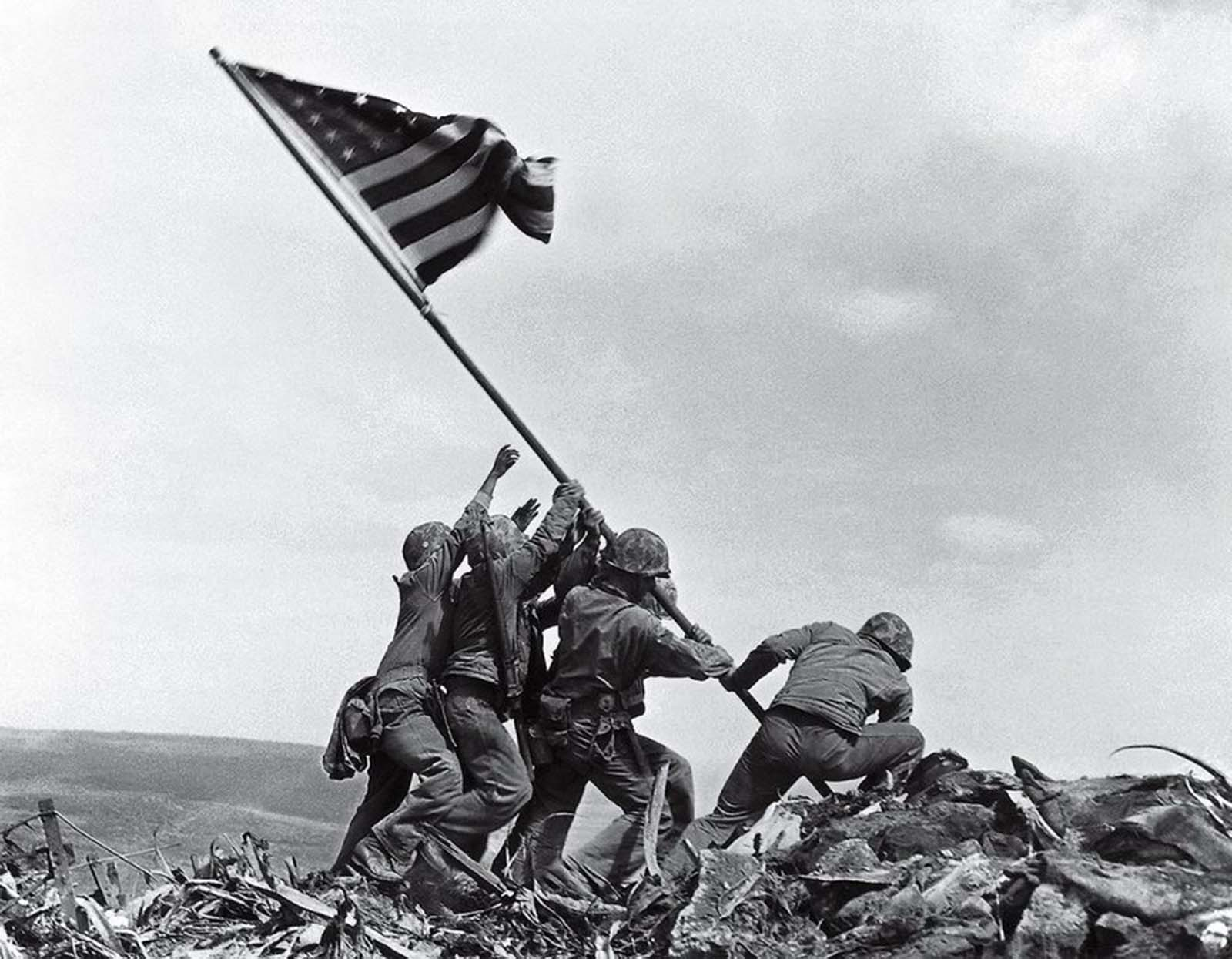
The photo shows six U.S. Marines raising an American flag atop Mount Suribachi during the Battle of Iwo Jima, one of the bloodiest and most brutal engagements of the Pacific campaign in World War II. Capturing the strategic volcanic island was seen as critical since it could provide an airbase for fighter escorts and emergency landings for bombers striking Japan.
This was actually the second flag raised on Suribachi that day. A smaller flag had been raised earlier that morning by a different group of Marines, and photographed by Marine photographer Louis Lowery. Commanders decided to replace it with a larger flag so it would be more visible across the island, and it was during this second raising that Rosenthal snapped his famous shot — largely instinctively, without much time to compose the image.
The men in the photo were Michael Strank, Harlon Block, Franklin Sousley, Ira Hayes, Harold Schultz, and Harold Keller (the identities were disputed and corrected multiple times over the decades, notably in 2016 and 2019, as some individuals had been misidentified). Of the six, three — Strank, Block, and Sousley — were killed in the fighting on Iwo Jima before the battle ended.
The photo won the Pulitzer Prize for Photography in 1945, the only photo to win the award the same year it was published. It became an enduring symbol of American perseverance and sacrifice in WWII, was used to help sell war bonds, and later became the basis for the U.S. Marine Corps War Memorial in Arlington, Virginia. It remains one of the most reproduced images in the history of photography.
The battle itself was extraordinarily costly — it lasted over a month, and the U.S. suffered nearly 7,000 dead and over 19,000 wounded, while nearly the entire Japanese garrison of over 20,000 was killed. It’s often cited as one of the few Pacific battles where American casualties exceeded Japanese ones.