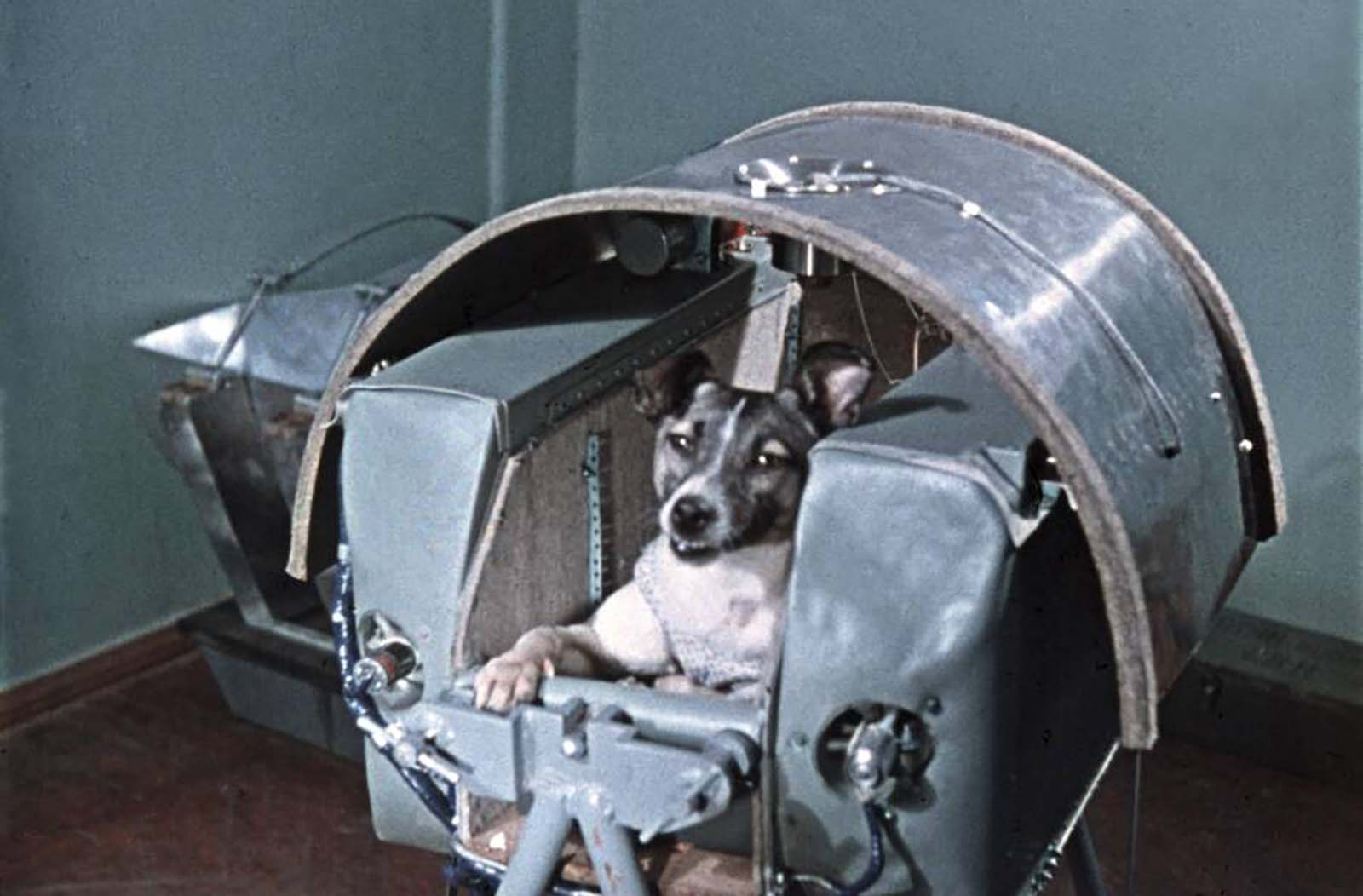
Laika (from Russian Лайка: “Barker”) was a stray dog from the streets of Moscow who became the first living creature to orbit the Earth, launched into outer space aboard the Soviet Sputnik 2 spacecraft on November 3, 1957.
Her journey marked a monumental milestone in the Space Race, proving that a living organism could survive the launch and microgravity conditions, though her story remains one of the most heartbreaking chapters in cosmic exploration.
The image provided shows her wearing her custom biometric harness inside the small pressurized training capsule that prepared her for the final mission.
Laika was not a purebred or a coddled pet; she was a mongrel (likely a mix of Husky and Terrier) roughly three years old, found wandering through the freezing winter streets of Moscow.
Soviet scientists specifically scouted street strays because they assumed animals that had already survived extreme hunger, bitter cold, and harsh street environments would have a far superior physical and psychological resilience compared to domestic pets.
Only female dogs were selected for a purely practical and anatomical engineering reason: the waste-collection system built into the spacesuit and restraints was designed exclusively for female anatomy, requiring that the animal did not have to lift its leg to urinate.
Laika and two other dogs (Albina and Mushka) underwent brutal testing. They were confined to increasingly smaller capsules for weeks at a time to accustom them to the tiny cockpit, spun in massive centrifuges to simulate the crushing G-forces of launch, and exposed to deafening rocket noise simulations. Laika was ultimately selected for the flight due to her exceptionally calm, patient, and sweet temperament.
In 1957, Soviet technology was advanced enough to put a rocket into orbit, but engineers had not yet developed a heat shield or the re-entry technology needed for a spacecraft to safely survive the atmospheric plunge and land. Sputnik 2 was strictly a one-way trip.
The official plan was to keep Laika alive in orbit for about seven days. The cabin was equipped with an automatic fan to regulate temperature, a nutrient-dense gelatinous food dispenser, and biological sensors to monitor her heart rate and blood pressure. The protocol dictated that after a week of data collection, a final portion of poisoned food would be administered to grant her a painless, automated euthanasia before the oxygen supply ran dry.
In October 2002 during a space congress in Houston by Soviet scientist Dmitry Malashenkov:
-
During takeoff, Laika’s pulse spiked to a terrifying rate, nearly tripling her resting heart rate due to absolute panic caused by the deafening roar and vibration.
-
While she reached orbit and her vitals slowly began to stabilize, disaster struck a few hours later. Due to a technical failure during the separation of the rocket stages, a piece of the thermal insulation did not detach properly.
-
The cooling system quickly failed, and the cabin temperature soared past 40°C (104°F).
-
Laika passed away just five to seven hours into the flight, during her fourth orbit, a victim of extreme stress, dehydration, and severe heat exhaustion. The spacecraft continued to orbit the Earth with her body inside for five months (circling the globe 2,570 times) before burning up completely upon re-entering the atmosphere on April 14, 1958.
Laika’s sacrifice immediately sparked a worldwide ethical debate about the use of animals in scientific research. Years later, Oleg Gazenko, one of the lead scientists of the Soviet space program, publicly expressed his profound regret:
“The more time passes, the more I’m sorry about it. We shouldn’t have done it… We did not learn enough from this mission to justify the death of the dog.”
Today, Laika is a global icon of space exploration. In 2008, the Russian government unveiled a striking bronze monument in Moscow in her honor: a statue featuring a space rocket transforming into a human hand, gently holding the figure of the little stray dog who touched the stars.
The Soviet Space Program (often archived globally under official state press credits like Sovfoto or TASS).