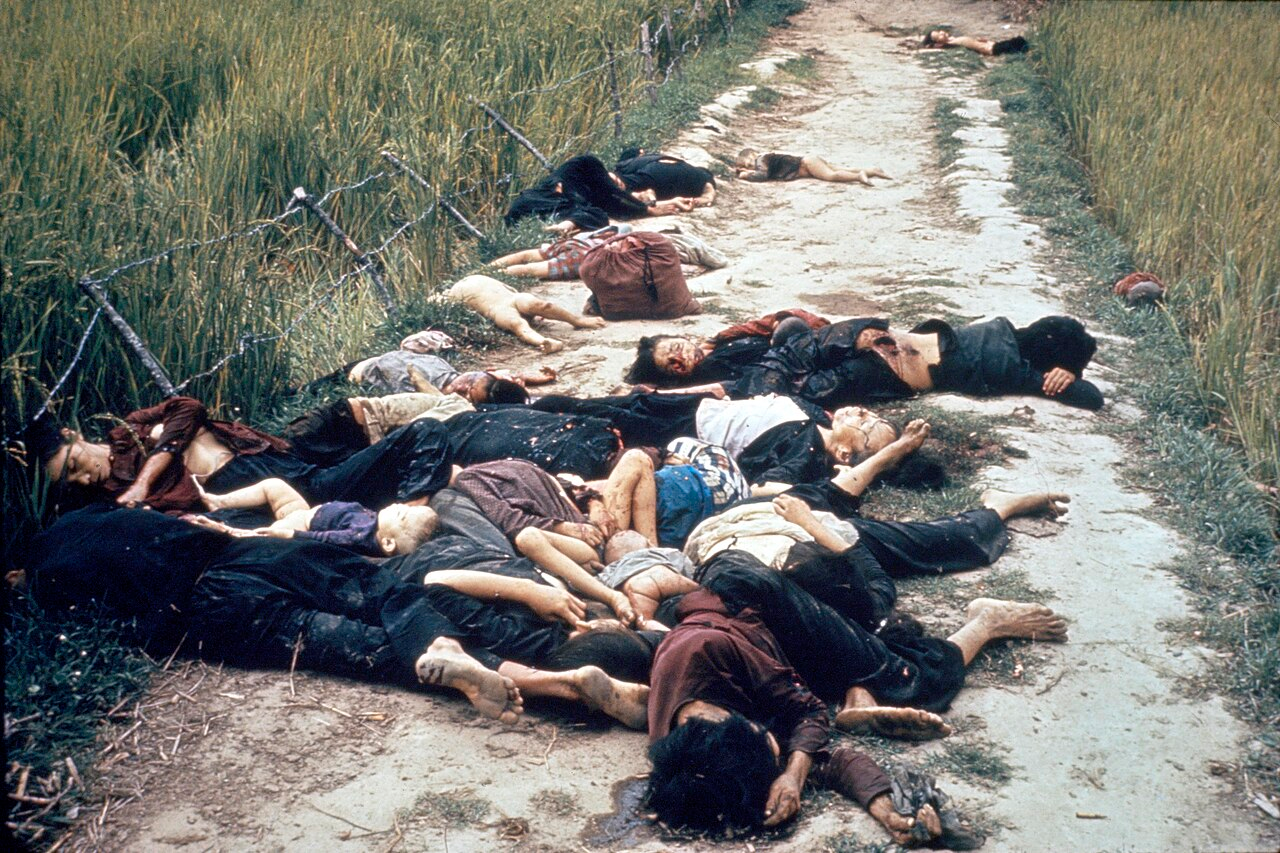
The My Lai Massacre was a horrific war crime committed by U.S. Army soldiers on March 16, 1968 (rather than 1967), during the Vietnam War. It involved the mass murder of between 347 and 504 unarmed Vietnamese civilians—predominantly women, children, and elderly men—in the hamlets of Sơn Mỹ village, Quảng Ngãi province.
It stands as the largest and most shocking massacre committed by U.S. troops in the 20th century, becoming a tipping point that deeply fractured American public support for the war.
In early 1968, the U.S. Military launched intensive counter-offensives following the Tet Offensive. Charlie Company (part of the 11th Infantry Brigade) was sent into the area of Sơn Mỹ—code-named “Pinkville” by U.S. forces—on a strict “search and destroy” mission.
The soldiers were highly frustrated, having suffered numerous casualties from hidden mines and booby traps over the preceding weeks without ever seeing the enemy face-to-face. Intelligence reports falsely suggested that the 48th Viet Cong Battalion was hiding in the village and that all innocent civilians would have left for the market. Superior officers gave ambiguous but aggressive orders to “clean out” the area, destroy livestock, burn houses, and leave nothing standing.
When the troops landed via helicopters on the morning of March 16, they found absolutely no enemy combatants and encountered zero resistance. Instead, they only found quiet families cooking breakfast.
Despite this, under the direct field command of Second Lieutenant William Calley, the platoon leaders ordered the slaughter. Over the course of four brutal hours, ordinary American soldiers systematically murdered hundreds of defenseless villagers:
- Groups of women and children were herded into a drainage ditch and gunned down at close range with automatic weapons.
- Dozens of women and girls, some as young as 12, were subjected to gang-rapes and sexual assault before being mutilated and murdered.
- Dwellings were set on fire with families trapped inside, livestock was slaughtered, and crops were poisoned.
The killing only came to an end due to the incredible moral courage of an army helicopter crew. Warrant Officer Hugh Thompson Jr. was flying a reconnaissance helicopter over the village when he noticed the piles of civilian bodies.
Realizing what his own country’s troops were doing, Thompson landed his helicopter directly between the advancing American soldiers and a group of terrified, fleeing Vietnamese civilians. He ordered his door gunners, Lawrence Colburn and Glenn Andreotta, to open fire on the U.S. soldiers if they attempted to murder any more civilians. Thompson then successfully evacuated the surviving villagers to safety and reported the atrocities to his superiors, forcing an immediate ceasefire order
The U.S. military command immediately covered up the atrocity for over a year, officially reporting the event to the public as a resounding military victory against 128 Viet Cong combatants.
The truth finally broke in November 1969, when investigative journalist Seymour Hersh published the story, accompanied by horrific color photographs taken by army photographer Ronald Haeberle. The revelation triggered immense moral outrage and massive anti-war protests across the United States.
Despite the scale of the war crime, justice was heavily compromised:
Out of 30 military personnel implicated in the killings or the cover-up, only 14 were charged, and almost all were acquitted or had their cases dismissed.
Lieutenant William Calley was the only soldier convicted of premeditated murder. Sentenced to life in prison, his punishment was sharply mitigated by political intervention. President Richard Nixon intervened, allowing Calley to serve his sentence under house arrest instead. He was paroled in 1974 after serving just over three years.