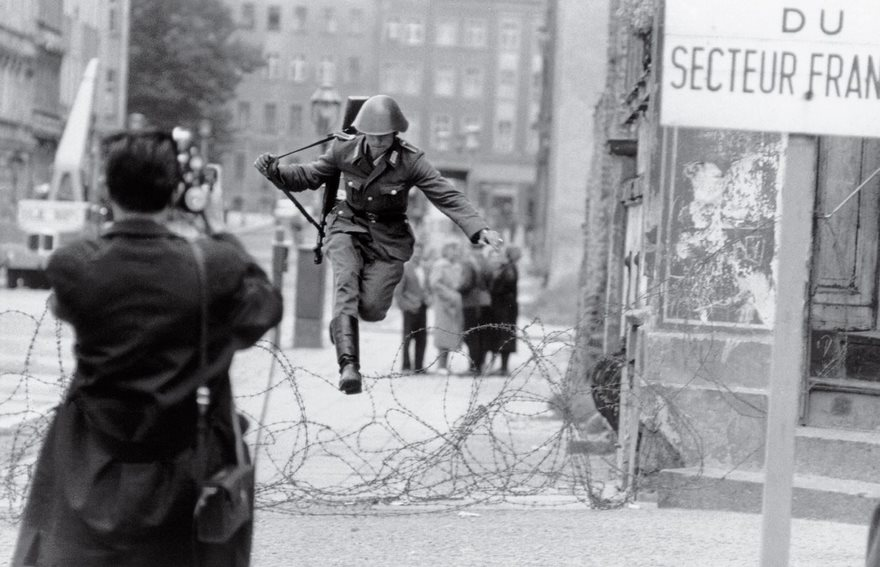
On August 13, 1961, the East German government began sealing off the border to stop its citizens from fleeing to the West. In those first few days, the “wall” was not yet a massive concrete structure; it was merely a single coil of concertina barbed wire strung across city streets.
On August 15, a 19-year-old East German conscript named Hans Conrad Schumann was stationed to guard the sector boundary on Bernauer Straße. As he stood duty, he watched in horror as families were forcibly torn apart and West Berliners stood across the line shouting protests. When he saw supply trucks pulling up with heavy concrete blocks and more barbed wire, a sudden panic seized him: he realized he would be permanently enclosed in the East if he did not act immediately.
Schumann’s leap was not entirely random; it was a tense, calculated choice. Over several hours, he subtly signaled his intentions to the crowd on the Western side:
He repeatedly trampled a section of the barbed wire down with his boot to lower the height.West Berlin citizens noticed his nervousness and silently coordinated. They positioned a West Berlin police van nearby with its back doors wide open, shouting to him, “Komm rüber!” (“Come over!”).
At around 4:00 PM, Schumann tossed his cigarette, sprinted forward, unslung his loaded PPSh-41 submachine gun, and vaulted cleanly into the air. Leibing pressed the shutter at the precise moment Schumann was suspended mid-air, capturing the perfect juxtaposition of a military uniform, a flying weapon, and a leap toward liberty.
Settling in Bavaria, Schumann lived in constant, paralyzing terror of retaliation or assassination by the East German secret police (the Stasi). (the)
His family back in East Germany faced intense harassment and interrogation by the state. He was completely cut off from his parents and siblings, receiving forged letters orchestrated by the regime begging him to return to a trap.
Even after the Berlin Wall fell in 1989 and Germany was reunited, Schumann struggled to overcome the profound guilt, isolation, and clinical depression linked to his fame.
He committed suicide in his orchard in Upper Bavaria on June 20, 1998.
In May 2011, Peter Leibing’s photograph was officially inducted into the UNESCO Memory of the World programme as part of the collection documenting the fall of the Berlin Wall, cementing its place as a priceless relic of 20th-century history.