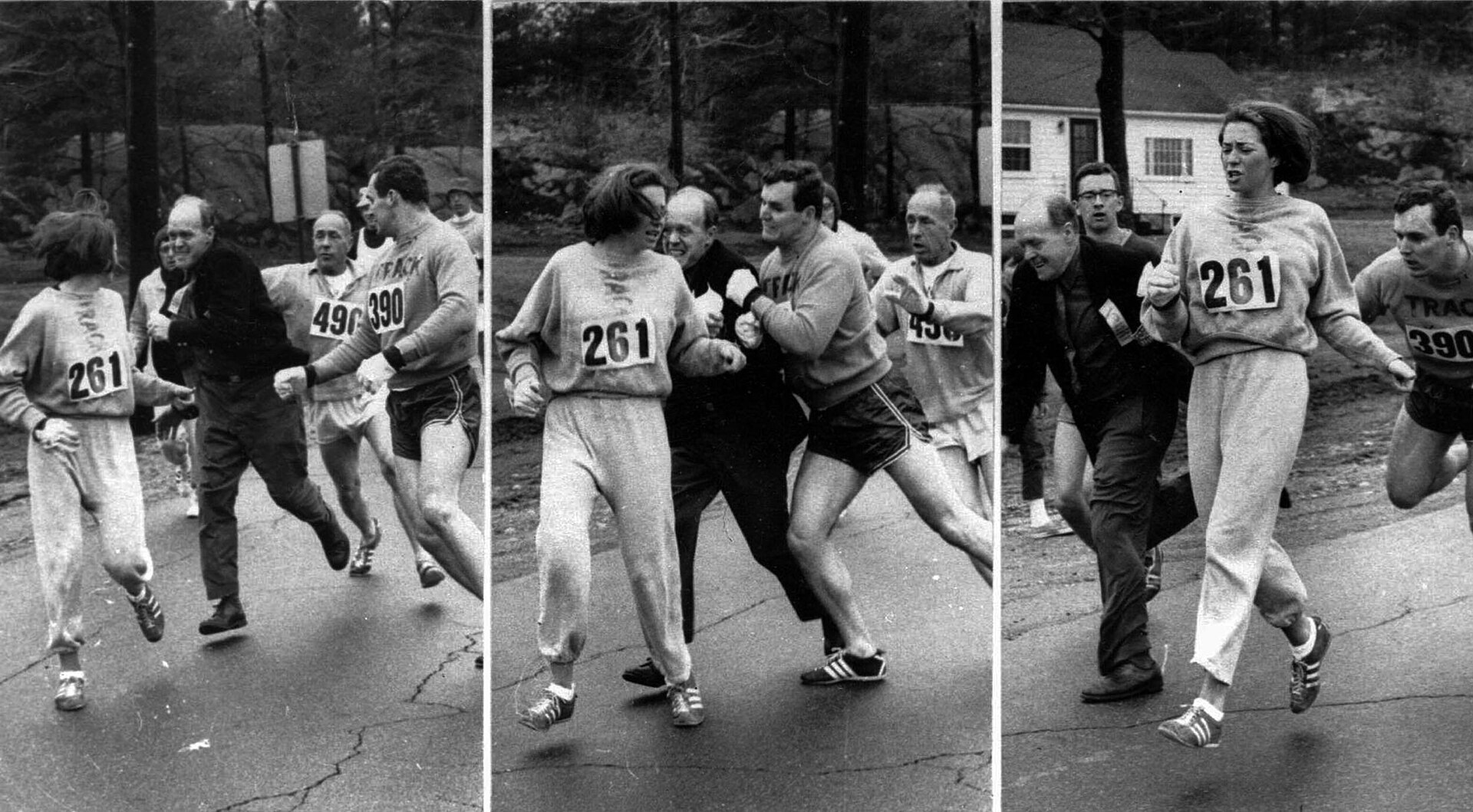
The picture depicts Kathrine Switzer at Boston Marathon in 1967. She was a journalism student at Syracuse University, who had been training with the men’s cross-country team.
But major marathons at the time had an official rule barring women from competing because it was thought women were incapable of running such miles or even could be dangerous for them.
She wanted to prove she could, so she signed as K. V. Switzer as she used to. Race organiers didn’t notice or question the entry, and was given the bib number 261.
After a few miles into the race, Jock Semple, the Boston Marathon’s co-race director spotted her and became furious. He jumped off the press truck and ran after her, shouting “Get the hell out of my race!” while grabbing at her jersey and trying to physically rip off her bib number.
Tom Miller, Switzer’s boyfriend at the time and a nationally ranked hammer thrower running alongside her (bib 390) body-blocked Semple, sending him sprawling. She and her coach Arnie Briggs (bib 490), kept movingg forward.
Switzer could finish the race. There was another woman who ran that day, Roberta “Bobbi” Gibb, but as she hid in the bushes to start and ran without a registration bib, she was not officially counted at the time.
The fallout from the 1967 race eventually forced the Amateur Athletic Union (AAU) to officially welcome women into the Boston Marathon starting in 1972.
The confrontation motivated Switzer to dedicate much of her life to women’s running advocacy. She helped create the Avon International Running Circuit for women (which run from 1978 to 1984) and was a driving force behind getting the women’s marathon added to the 1984 Olympics.
In 2017, on the 50th anniversary, 70-years-old Switzer ran Boston again wearing bib 261, which the Boston Athletic Association subsequently retired in her honor.
She also founded 261 Fearless, a global nonprofit that uses running to empower women, named directly after that bib number.