Soil is the thin layer of mineral and organic material that blankets the Earth’s surface and sustains terrestrial life. Far from being just inert dirt, soil is a dynamic, living, and finite ecosystem that filters water, recycles vital nutrients, and acts as one of the planet’s most critical carbon sinks.
-
Mineral Matter (45%): Small fragments of weathered rock classified by particle size into sand, silt, and clay. The ratio of these three elements dictates the soil’s texture and its ability to hold or drain water.
-
Water (25%) and Air (25%): These occupy the pore spaces between solid particles. Air provides the oxygen required by plant roots and microorganisms, while water dissolves and transports the nutrients needed to grow global food supplies.
-
Organic Matter (5%): Composed of living organisms (earthworms, fungi, bacteria) and plant or animal debris in various stages of decay.
Soil forms incredibly slowly through the weathering of bedrock driven by climate, water, and living organisms. It takes between 200 and 400 years to generate just one centimeter of fertile topsoil. A vertical cross-section reveals distinct layers called horizons:
-
Horizon O (Organic Layer): The uppermost surface layer, composed of fresh leaf litter, twigs, and organic waste.
-
Horizon A (Topsoil): The critical, dark-colored zone rich in humus (fully decomposed organic matter) and biological activity. This is the primary zone for agriculture and plant growth.
-
Horizons B and C: Deeper layers where leached minerals accumulate, transitioning directly into the underlying bedrock studied in geology.
Land Degradation and Desertification
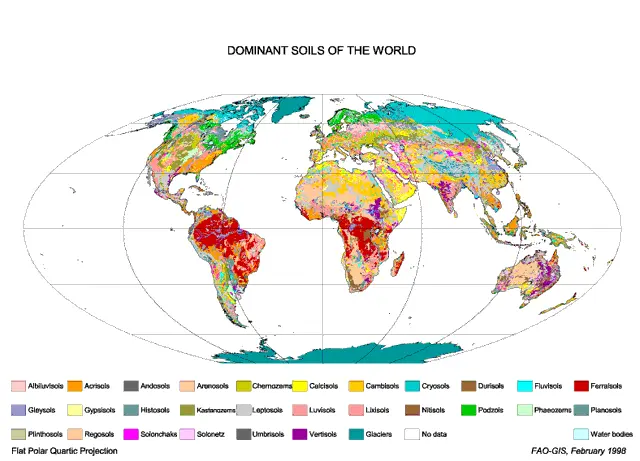 Main soils of the World. Source: FAO

Classificacation by the International Union of Soil Sciences (IUSS)