The orangutan (genus Pongo) is a large, reddish-orange great ape native to the rainforests of Borneo and Sumatra in Southeast Asia.
Known as the world’s largest tree-dwelling mammal, its name comes from the Malay phrase orang hutan, which literally translates to “person of the forest.”
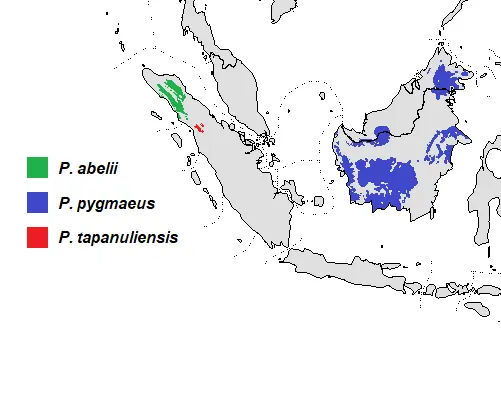
All three living species of orangutans are classified as Critically Endangered on the IUCN Red List:
-
Bornean orangutan (Pongo pygmaeus). Native to the island of Borneo, it has a broader face, shorter beard, and slightly darker reddish-brown coat than its Sumatran relative.
-
Sumatran orangutan (Pongo abelii). Found in northern Sumatra, it has a narrower face, longer facial hair, and a paler, more orange-tinted coat.
-
Tapanuli orangutan (Pongo tapanuliensis). Described as a distinct species in 2017, it lives exclusively in the Batang Toru forest of South Tapanuli in Sumatra and is the rarest great ape in the world, with fewer than 800 individuals remaining.
 Orangutans spend over 90% of their lives in trees. Their long, powerful arms can span over 2 meters (6.6 feet)—significantly longer than their standing height of about 1.2 to 1.5 meters (4 to 5 feet)—and their hands and feet are shaped like hooks for gripping branches.
Dominant adult males develop large, fleshy cheek pads called flanges along with a throat sac used to produce booming “long calls” that echo through the forest to attract females and warn off rivals.
Unlike gorillas, chimpanzees, and bonobos, orangutans do not live in large social troops. Adult males are largely solitary, while adult females live with their dependent offspring.
Females give birth to a single infant only once every 7 to 9 years, nursing and teaching their young essential survival skills (like foraging and nest-building) for up to eight years.
Sharing roughly 97% of their DNA with humans, orangutans are remarkably intelligent. They use sticks to extract insects and honey, craft leafy “umbrellas” to shield themselves from rain, and weave a brand-new sleeping nest out of branches high in the trees every single night.
Wild fruits (such as durian, figs, and jackfruit) make up the bulk of their diet, complemented by leaves, bark, flowers, honey, and insects. By traveling through the canopy and dispersing seeds, they play a vital role as “gardeners of the forest.”
Wild populations have plummeted primarily due to rapid deforestation for palm oil plantations, logging, mining, and forest fires, as well as illegal poaching for the exotic pet trade.