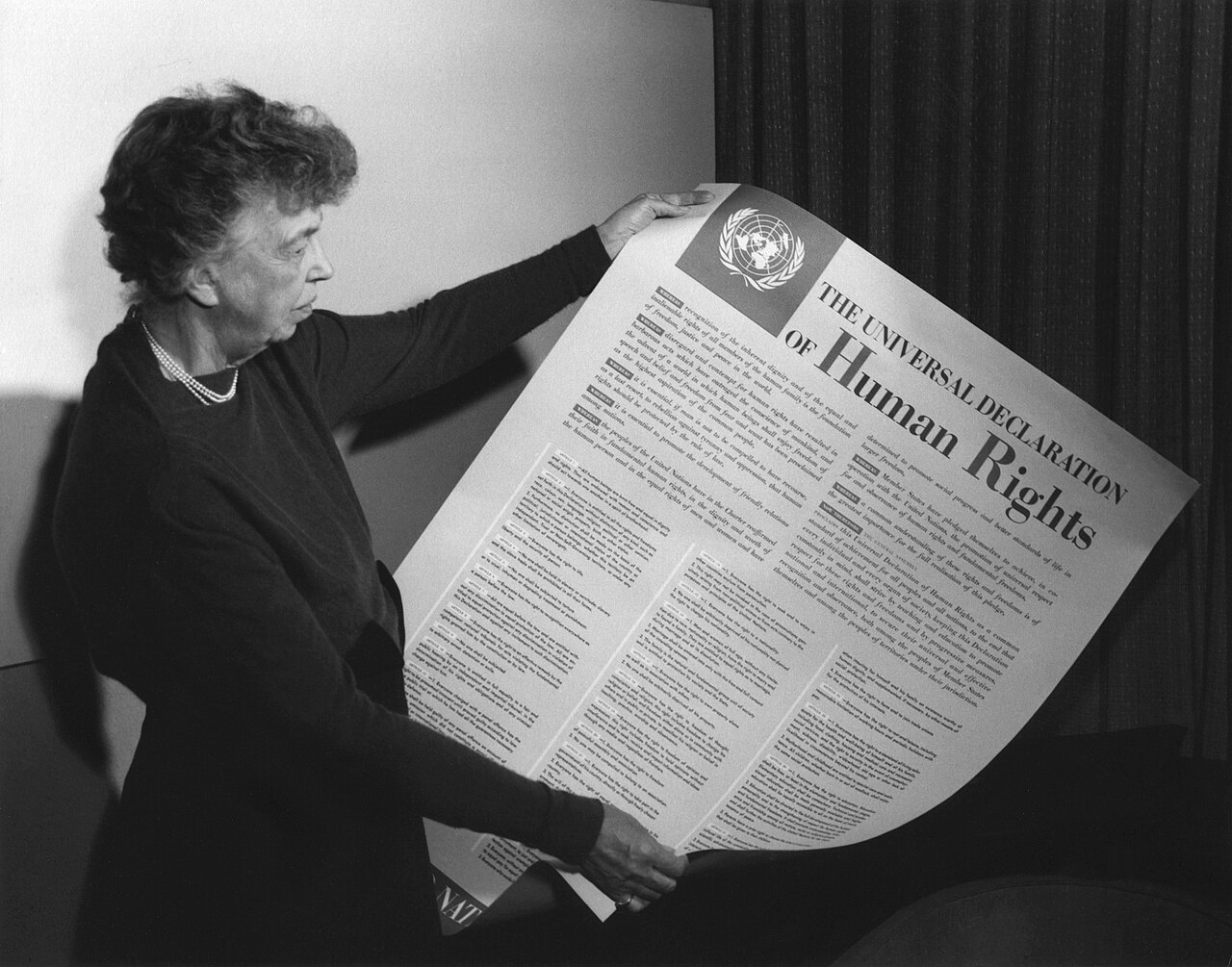
Eleanor Roosevelt (1884–1962) was an American diplomat, author, and politician who served as the First Lady of the United States from 1933 to 1945 during the presidency of her husband, Franklin D. Roosevelt.
She radically redefined the role of the First Lady, transforming it from a purely ceremonial position into a powerful platform for political and social activism. Following her time in the White House, she became a global leader, most famously serving as the first Chairperson of the United Nations Commission on Human Rights (OHCHR).
The Universal Declaration of Human Rights (UDHR) is a milestone document in the history of human rights. Drafted by representatives with different legal and cultural backgrounds from all regions of the world, the Declaration was proclaimed by the United Nations General Assembly in Paris on 10 December 1948 (General Assembly resolution 217 A) as a common standard of achievements for all peoples and all nations.
It sets out, for the first time, fundamental human rights to be universally protected and it has been translated into over 500 languages, making it the most translated document in world history.
The UDHR was born directly out of the horrors of World War II and the Holocaust. With the creation of the United Nations in 1945, the international community vowed never again to allow the atrocities committed during the war to happen.
A formal drafting committee was established, chaired by Eleanor Roosevelt (the former First Lady of the United States), who played a monumental role as a driving force behind the document, famously calling it the “International Magna Carta for all mankind.” Other key visionaries included René Cassin of France, Charles Malik of Lebanon, and Peng Chun Chang of China.
The Declaration consists of a preamble and 30 articles that encompass a broad range of fundamental rights and freedoms to which every single human being is entitled, without distinction of race, color, sex, language, religion, or political opinion. The articles can be broken down into four main pillars:
-
Pillar 1: Right to Liberty and Equality (Articles 1-2): These set the foundation of human dignity, stating that “all human beings are born free and equal in dignity and rights.”
-
Pillar 2: Civil and Political Rights (Articles 3-21): These protect individual liberties, including the right to life, liberty, and security; the prohibition of slavery and torture; equality before the law; the right to a fair trial; freedom of movement, thought, conscience, religion, and expression.
-
Pillar 3: Economic, Social, and Cultural Rights (Articles 22-27): These guarantee social security, the right to work, fair wages, the right to education (a direct connection to activists like Malala Yousafzai [Malala Yousafzai]), and participation in the cultural life of the community.
-
Pillar 4: International Order and Duty (Articles 28-30): These declare that everyone is entitled to a social and international order in which these rights can be fully realized, while emphasizing that individuals also have duties to their community.
Technically, the UDHR is not a treaty, meaning it is not directly legally binding on countries. It was adopted as a declaration of principles.
However, its impact on international law is unparalleled. It served as the foundation for two binding UN treaties that entered into force in 1976: the International Covenant on Civil and Political Rights and the International Covenant on Economic, Social and Cultural Rights. Together with the UDHR, these documents form the International Bill of Human Rights. Today, many of its principles have become part of customary international law, meaning they are universally accepted as binding legal standards.